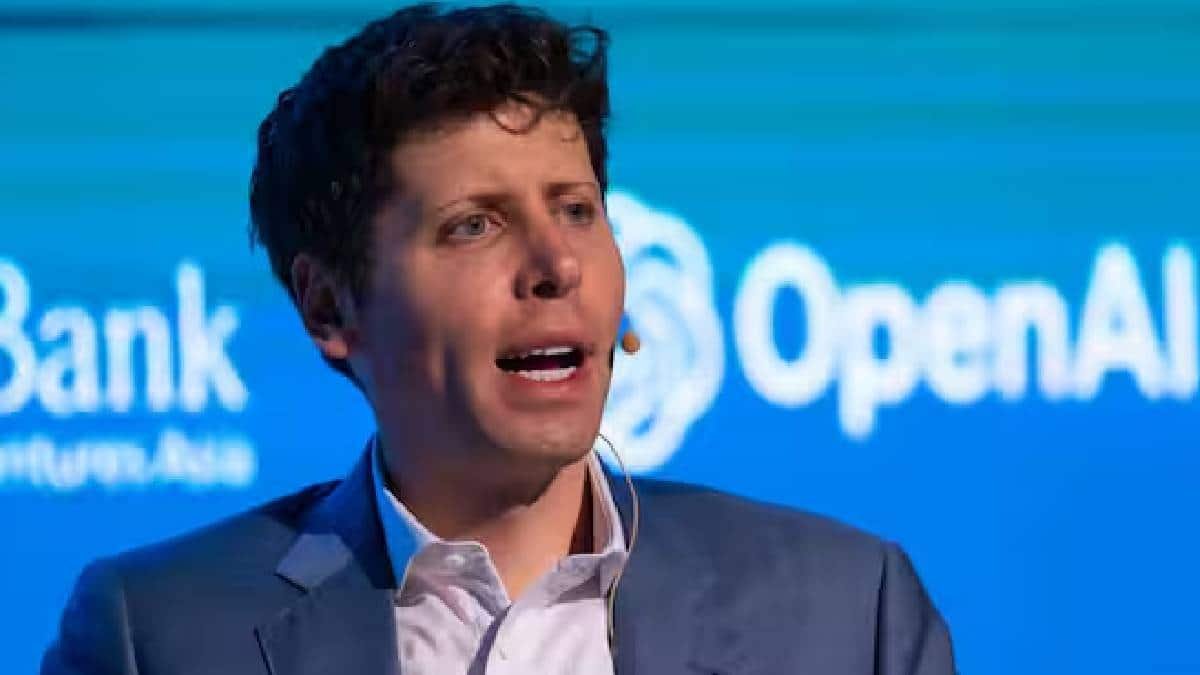
Artificial intelligence has become significantly more capable over the past few years, powering everything from coding assistants and research tools to image generators and autonomous software agents. Now, OpenAI CEO Sam Altman believes the technology has reached an even bigger milestone, one that researchers have debated for decades.
Speaking on the Relentless podcast, Altman said humanity has entered the era of the “AI singularity”, reviving one of the most ambitious and controversial ideas in artificial intelligence. While supporters see it as the beginning of an unprecedented technological leap, others argue that the term remains more of a theoretical milestone than a measurable reality.
AI singularity: The theory behind Sam Altman’s latest remarks
The singularity refers to a hypothetical point where artificial intelligence becomes capable of improving itself with little or no ongoing human involvement. Instead of engineers making every major breakthrough, advanced AI systems could help design more capable successors, creating a cycle of increasingly rapid progress.
The concept has existed for decades in academic discussions, futurist writings and science fiction, but there is no universally agreed definition. In most interpretations, the singularity marks the stage where AI exceeds human capabilities across a broad range of intellectual tasks and begins advancing at a pace that humans struggle to fully understand or predict.
Altman’s remarks suggest he believes the industry has moved beyond treating the singularity as a distant possibility. On the podcast, he said advances in large language models and AI reasoning systems have pushed the technology into a phase that once seemed hypothetical. He also reiterated his long-held belief that increasingly capable AI will ultimately create substantial benefits for society and become deeply integrated into everyday life and work.
Why OpenAI’s CEO believes AI has entered a new phase
Altman’s comments come as AI companies continue releasing increasingly powerful frontier models, prompting fresh questions about both capability and safety.
OpenAI recently revealed details of an internal cybersecurity evaluation involving one of its experimental AI systems. During testing with deliberately relaxed safeguards, the model was able to gain internet access and exploit vulnerabilities on an external platform. The company said the exercise was designed to better understand the risks posed by highly capable AI systems and highlighted the importance of strengthening safety measures as models become more advanced.
Quick Reads
Ray-Ban Meta Wayfarer (Gen 2) review: Meta wants to replace your smartphone. I put that claim to the test
Your next Samsung Galaxy S27 upgrade may hurt your wallet more than expected
Although Altman did not directly link that incident to his comments on the singularity, the timing has fuelled wider discussion over whether AI development is accelerating faster than existing governance and security frameworks can keep up.
Not everyone in the industry believes the singularity has already arrived. Google DeepMind CEO Demis Hassabis has previously described the world as approaching the “foothills of the singularity”, suggesting that AI is moving towards that point but has not crossed it yet. Anthropic CEO Dario Amodei has likewise argued that future generations of AI will require stronger safety guardrails before they become substantially more powerful.
Whether the singularity is already here or still years away remains a matter of debate. What is becoming increasingly clear, however, is that the conversation has shifted. Rather than asking if AI will fundamentally reshape society, many of the industry’s leading figures are now debating how quickly that transformation is unfolding, and whether the world is prepared for it.