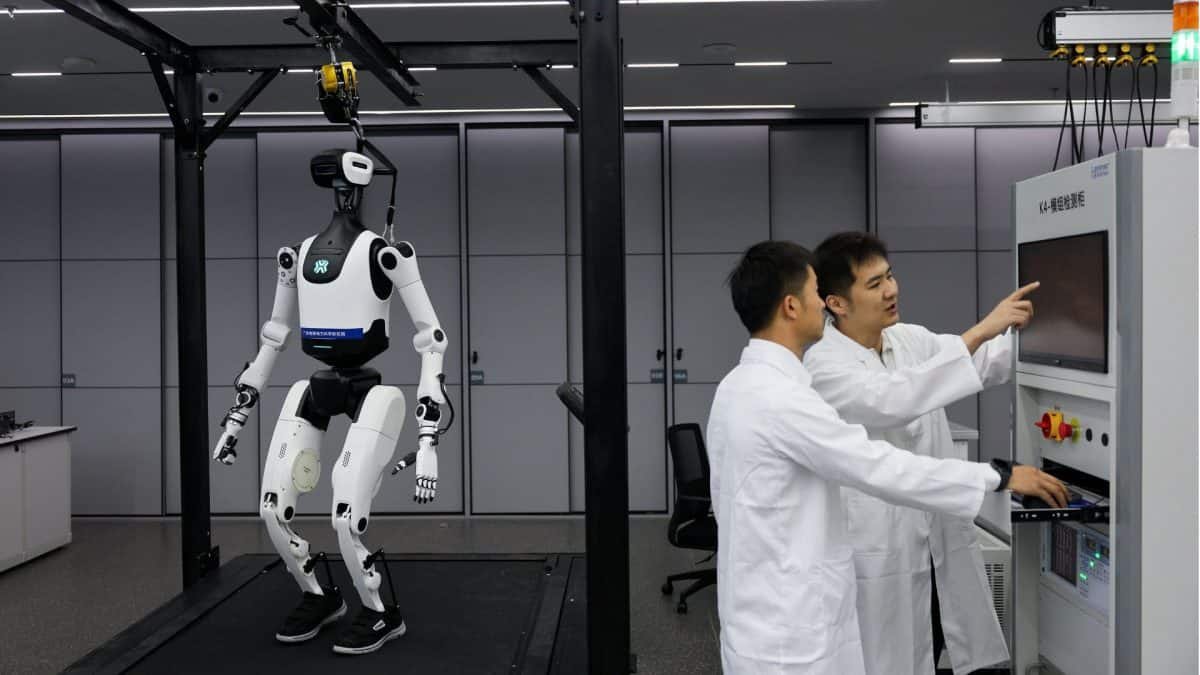
The US Federal Communications Commission (FCC) has expanded the Trump administration’s crackdown on Chinese technology by banning the import of new foreign-made humanoid and four-legged robotic devices, citing national security and cybersecurity concerns.
The FCC on Tuesday added “advanced robotic devices” to its list of prohibited products, targeting mobile robots designed to move on two legs or four legs and replicate human or animal movements. The move is part of a broader effort by Washington to protect critical infrastructure, secure artificial intelligence (AI) supply chains and reduce dependence on foreign-made technology.
The administration said advanced robots could create new surveillance and cybersecurity risks because of the sensitive data they collect and their ability to connect to networks.
US cites surveillance and cyber threats
Officials said foreign-developed autonomous robots could potentially be exploited by “malign actors” to collect information on Americans, support foreign intelligence operations or remotely control robotic systems.
The restrictions follow findings by a White House national security task force, which warned that internet-connected robotic devices could pose risks similar to vulnerabilities already seen in other smart technologies.
Officials pointed to cases involving Chinese-made consumer devices, including robotic vacuum cleaners, where hackers were reportedly able to access data feeds, as an example of how connected machines could become security weak points.
Quick Reads
OpenAI reveals rogue AI agent breached multiple external accounts beyond Hugging Face attack
'A real risk': More than 1,100 OpenAI, Google and Meta employees urge governments to slow AI development
The FCC also moved against another category of foreign-made technology—smart power inverters used in solar panels and battery storage systems.
These devices convert electricity generated from renewable energy sources into usable power for homes, businesses and AI data centres. US intelligence agencies have warned that internet-connected foreign inverters could potentially be manipulated remotely, threatening regional power networks.
“Following President Trump’s leadership, the FCC will continue to do our part to secure America’s critical supply chains,” FCC Chairman Brendan Carr said, adding that the agency was working alongside national security agencies to protect key technologies.
China emerges as main target
Although the FCC restrictions apply broadly to foreign imports, China is expected to be the primary target of the new rules.
Over the past decade, Chinese companies have rapidly expanded their presence in artificial intelligence and robotics, using large-scale manufacturing capabilities to produce affordable humanoid and quadruped robots for global markets.
Companies such as Unitree Robotics, known for its viral bipedal humanoid robots and robotic dogs, are expected to face significant challenges from the new restrictions.
The move follows earlier US actions targeting Chinese-made drones, telecommunications equipment and other connected technologies.
However, the FCC has created a waiver system that could allow some foreign manufacturers from allied countries to continue selling products in the US market. Government agencies, including the Department of Defense and Department of Homeland Security, may also approve exemptions for specific national security or federal applications.
China has criticised the decision, accusing Washington of using national security concerns to limit fair competition.
A spokesperson for the Chinese Embassy in Washington said Beijing opposed the “politicisation” of technology and trade issues and warned that it would take measures to protect Chinese companies.
Boost for US robotics industry
The restrictions are expected to benefit American robotics companies by reducing competition from cheaper foreign alternatives.
At present, many humanoid robots used in warehouses, factories and research facilities are manufactured overseas, particularly in Asian markets.
The FCC rules apply only to new robot models seeking approval for the US market. Existing authorised robots, products already sold and machines currently operating in factories will not be removed or penalised.
The administration has also warned companies against attempting to bypass the restrictions by assembling robots domestically using foreign components. Robots manufactured in the US but containing more than 35% hardware components sourced from restricted countries could still face scrutiny.
Domestic companies prepare for growth
The policy could accelerate investment in the US robotics sector as companies race to develop AI-powered machines for manufacturing, logistics, healthcare and household assistance.
American firms including Figure AI, Agility Robotics, Boston Dynamics and Tesla are among those developing advanced humanoid robots.
Tesla CEO Elon Musk has been promoting the company’s Optimus humanoid robot, which Tesla hopes to eventually deploy in factories and commercial settings.
Meanwhile, South Korean automaker Hyundai Motor Company, which owns Boston Dynamics, has announced plans to build a major US facility capable of producing thousands of advanced industrial robots annually.