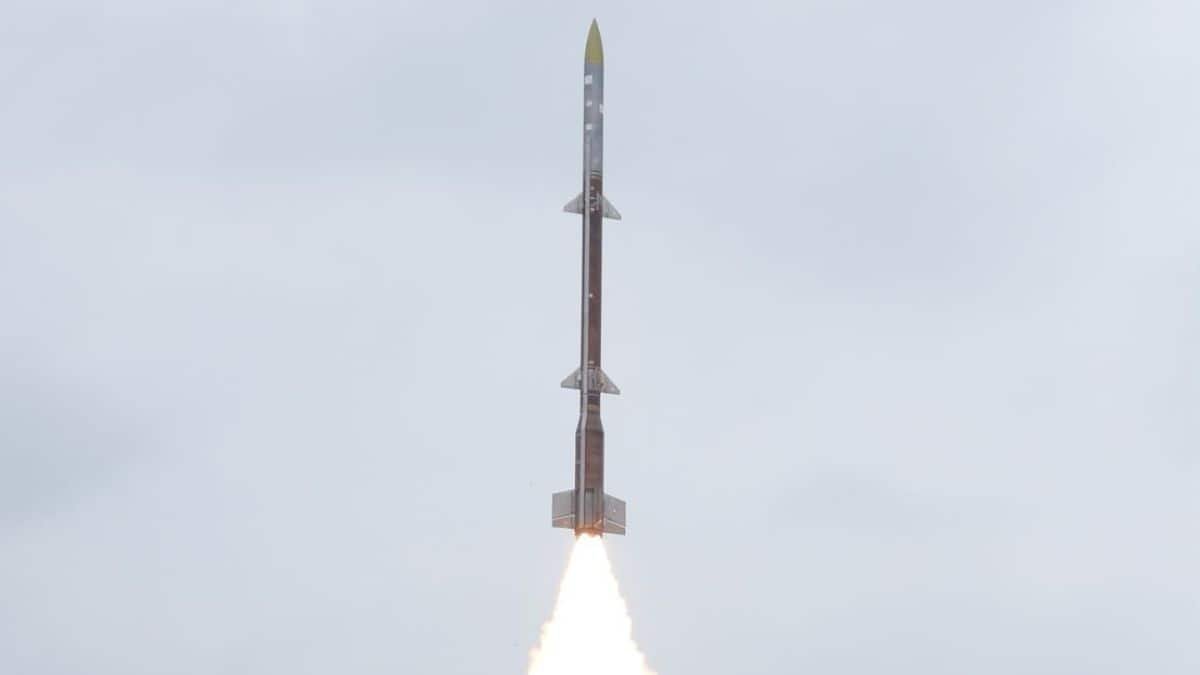
India’s Defence Research and Development Organisation (DRDO) successfully conducted the maiden flight-test of the Kusha Long-Range Surface-to-Air Missile (LRSAM) on Thursday (July 23, 2026).
Fired from the Integrated Test Range (ITR) at Dr APJ Abdul Kalam Island off the coast of Odisha, the missile intercepted a high-speed, high-altitude electronic target simulating a next-generation aerial threat.
The successful trial marks India’s entry into an elite tier of nations capable of indigenously designing, developing, and deploying long-range multi-tiered area air defence systems.
Developed under Project Kusha — also referred to as the Extended Range Air Defence System (ERADS) — the programme aims to establish a sovereign, multi-layered air defence shield across Indian airspace by the end of the decade, effectively neutralising dependence on foreign systems.
The launch occurred from Launch Complex IV of the APJ Abdul Kalam Island testing facility.
According to official Ministry of Defence statements, all mission objectives were met.
More from Explainers India successfully tests long-range 'Kusha' air defence missile system India must seize its demographic dividend before it fades Key flight test details: Target profile: An advanced electronic target simulating a low-radar-cross-section (RCS) stealth jet or high-altitude cruise missile traveling at supersonic speed.
Tracking & engagement: Ground-based Multi-Function Fire Control Radars (MF-FCR) and 3D Long-Range Observation Radars tracked the target continuously, feeding mid-course guidance updates via secure datalink to the missile before terminal seeker lock-on.
Kill mechanism: The flight-test validated the performance of the hybrid radio-frequency (RF) and infrared (IR) terminal seeker, along with the optical proximity fuze and pre-fragmented warhead.
Editor’s Picks 1Will democracy survive AI velocity?
India will decide, Kerala can lead 2PoK unrest revives Bharat’s great strategic ‘what if’ “The successful test flight of ‘Kusha’ marks an important milestone in Indian defence R&D,” stated Union Defence Minister Rajnath Singh.
This test eliminates foreign import dependency for such critical strategic systems and signifies a giant leap in the nation’s air defence posture,” he wrote on X.
Defence Secretary and Secretary of Department of Defence R&D (DRDO chairman) Rajesh Kumar Singh monitored the trial alongside senior leadership from the Indian Air Force (IAF) and strategic industry partners.
How does Kusha work?
Project Kusha was formally sanctioned by the Cabinet Committee on Security (CCS) in May 2022 and received an Acceptance of Necessity (AoN) from the Defence Acquisition Council (DAC) in September 2023 for Rs 21,700 crore (approximately $2.6 billion) to procure five squadrons for the Indian Air Force.
Unlike single-missile systems, Project Kusha uses three distinct interceptor missiles (designated M1, M2, and M3) operating from common, mobile Transporter Erector Launchers (TELs) to provide defence-in-depth: M1 interceptor (Range: 120-150 km): Optimised for medium-to-long-range engagements against incoming tactical strike aircraft, anti-radiation missiles, and low-flying manoeuvrable cruise missiles.
M2 interceptor (Range: 250 km): Designed to counter high-altitude stand-off jammers, heavy strategic bombers, and long-range unmanned aerial vehicles (UAVs) before they reach weapon-release lines.
M3 interceptor (Range: 350-400 km): India’s longest-range anti-access/area-denial (A2/AD) weapon, capable of destroying Airborne Early Warning and Control (AEW&C) platforms, intelligence-gathering aircraft, and incoming short-to-medium-range ballistic or hypersonic threats at high altitudes.
Propulsion, guidance, and lethality: Speed: Driven by dual-pulse solid-propellant rocket motors with thrust-vectoring nozzles, achieving speeds exceeding Mach 5.5.
Guidance suite: Combines inertial navigation (INS) with satellite-assisted mid-course datalink corrections, transitioning to an active dual-mode Active Electronically Scanned Array (AESA) millimetre-wave RF seeker and electro-optical/infrared (IR) seeker during the terminal phase.
Hit-to-Kill lethality: Incorporates both directional high-explosive fragmentation warheads with optical proximity fuzes and direct hit-to-kill kinetic impact technology for ballistic intercept modes.
How will Kusha complement India’s Layered Air Defence Shield?
Project Kusha is designed to function as the outer perimeter of India’s multi-layered air defence grid, bridging the gap between medium-range tactical systems and strategic anti-ballistic missile (ABM) interceptors.
Defence layerSystemsRangeStrategic layerKusha; BMD Phase I/II (PAD/AAD)Kusha: 150-400 kmLong-/Medium-Range Air DefenceS-400 Triumf; MRSAM / Barak-8S-400: 400 km; MRSAM / Barak-8: 70 kmShort-/Medium-Range Air DefenceAkash-NG; QRSAM30 km (Akash-NG); 30 km (QRSAM)Point DefenceVSHORAD; Igla-S; L-70 and ZSU anti-aircraft gunsVery short range / point defenceProject Kusha operates within the Indian Air Force’s Integrated Air Command and Control System (IACCS) — a fully automated, secure C4ISR network connecting civilian and military radars across the nation.
Under the broader Mission Sudarshan Chakra initiative, Kusha links with: S-400 Triumf batteries already deployed along northern and western borders.
MRSAM (Medium Range Surface-to-Air Missile) units protecting vital industrial and military assets.
Akash-NG and QRSAM tactical units providing frontline protection for army strike corps.
By utilising multi-sensor data fusion, an enemy aircraft or missile detected by a sea-based naval radar or an airborne AEW&C platform can be engaged by a land-based Kusha launcher without the launcher turning on its own search radar until the terminal phase, drastically lowering vulnerability to anti-radiation missiles.
How does Kusha compare with other global air defence systems?
To evaluate Kusha’s standing among global surface-to-air missile systems, Firstpost has benchmarked it against the world’s leading platforms: Russia’s S-400 Triumf, the United States’ MIM-104 Patriot (PAC-3 MSE) and THAAD, China’s HQ-9B, and Israel’s David’s Sling.
Feature / SystemDRDO Kusha (India)S-400 Triumf (Russia)MIM-104 Patriot PAC-3 (USA)THAAD (USA)HQ-9B (China)David’s Sling (Israel)Max Interception Range150 / 250 / 400 km40 km (9M96E) to 400 km (40N6E)30 to 160 km (PAC-3 MSE)200 km250 km250 (Stunner)Max Altitude30 km (100,000 ft)30 km24 km150 km (Exo-atmospheric)27 km15 kmMax SpeedMach 5.5+Mach 4.8 to Mach 12Mach 4.1Mach 8.2Mach 4.2Mach 7.5Guidance / SeekerHybrid Active AESA RF + IRCommand + Semi-Active/Active RFActive Millimetre Wave RadarInSb Focal Plane Array IRActive Radar HomingDual IR/CCDP + Active RadarTarget EngagementStealth Jets, AWACS, Hypersonic, BallisticAircraft, Cruise, Tactical BallisticBallistic Missiles, Stealth Jets, UAVsShort/Medium Range Ballistic MissilesAircraft, Cruise, Ballistic MissilesCruise, Ballistic, Large RocketsRadar Coverage360° AESA Multi-Function360° Panoramic Acquisition120° Phased Array (270° LTAMDS)120° Single-Face TPY-2 X-band360° Phased Array360° AESA (EL/M-2084)Kill MechanismDirectional Frag / Hit-to-KillBlast FragmentationKinetic Hit-to-KillPure Kinetic Hit-to-KillPre-fragmented HEKinetic Hit-to-KillSquadron Cost (Est.)~$500 Million (Indigenous)~$600-700 Million~$1.1-1.5 Billion~$2.5-3.0 Billion~$400 Million (Internal)~$300 Million (Battery)Kusha vs S-400 Triumf (Russia) India procured five squadrons of the Russian S-400 system under a $5.43 billion deal signed in 2018.
While the S-400 remains an effective long-range system, Project Kusha offers three distinct strategic advantages.
The S-400 relies on hybrid processing architecture developed in the early 2000s.
Project Kusha utilises state-of-the-art Gallium Nitride (GaN)-based AESA radars, providing superior clutter rejection, improved target resolution against low-RCS stealth threats (eg, Chengdu J-20 fighters), and high resistance to electronic jamming.
S-400 interceptors rely primarily on radar guidance.
Kusha’s M2 and M3 variants integrate a dual active RF and imaging infrared (IIR) seeker, rendering passive counter-measures and radar chaff ineffective during terminal phase intercept.
Russian geopolitical commitments and international sanctions created delivery delays for India’s remaining S-400 squadrons.
Kusha ensures domestic maintenance, software customisation, and continuous missile stockpiling through Indian supply chains.
Kusha vs MIM-104 Patriot PAC-3 MSE (USA) The US Army’s Patriot PAC-3 MSE is recognised for point-defence against tactical ballistic missiles and air-breathing threats.
Patriot is primarily a tactical point-defence system with an operational engagement range capped at approximately 160 km for aircraft and under 40 km for ballistic targets.
Kusha’s M3 interceptor extends defence coverage out to 400 km, creating a stand-off exclusion zone that forces enemy support aircraft (like refuelling tankers and AWACS) to operate hundreds of kilometres away from Indian borders.
Traditional Patriot radars operate on a sector-limited 120-degree field of view, requiring multiple radar units for all-around coverage.
Kusha integrates 360-degree rotating AESA multi-function fire control radars out of the box.
Kusha vs THAAD (USA) Terminal High Altitude Area Defence (THAAD) is a specialised upper-tier anti-ballistic missile defence platform operating at altitudes between 40 km and 150 km (exo-atmospheric).
THAAD is engineered specifically to hit incoming medium-range ballistic missiles in their terminal phase using pure kinetic energy.
Kusha, by contrast, is a multi-role area air defence system optimised for atmospheric targets (jets, cruise missiles, drones, hypersonic glide vehicles) up to 30 km altitude.
Rather than competing with THAAD, Kusha occupies a operational role similar to a combined S-400/Patriot capability, while India’s Phase II Ballistic Missile Defence (AD-1 and AD-2 interceptors) fulfills the exo-atmospheric role equivalent to THAAD.
Kusha vs HQ-9B/HQ-19 (China) China’s People’s Liberation Army Air Force (PLAAF) relies on the HQ-9B (range ~250 km) and the newer HQ-19 for long-range air defence.
The Chinese HQ-9B is based on S-300PMU2 technology with indigenous active radar upgrades.
Kusha’s M3 missile matches or exceeds the HQ-9B in range (400 km vs 250 km) and offers higher terminal speed (Mach 5.5 vs Mach 4.2).
This capability neutralises the PLAAF’s stand-off missile advantage across the mountainous terrain of the Line of Actual Control (LAC), where radar detection horizons are constrained by geography.
What next for Kusha?
Project Kusha represents a collaborative model between government research organisations and private defence manufacturing in India.
Key industrial stakeholders include: Bharat Electronics Limited (BEL): Serves as the primary system integrator and radar manufacturer.
BEL anticipates execution orders exceeding ₹40,000 crore ($4.8 billion) over the decade as Project Kusha scales into serial production.
Bharat Dynamics Limited (BDL): Responsible for missile assembly, solid rocket motor integration, warhead fitting, and canisterisation.
Private sector MSME ecosystem: Over 100 Indian micro, small, and medium enterprises (MSMEs) supply sub-assemblies, including carbon-composite airframe bodies, electro-mechanical actuator controls, onboard batteries, and high-frequency microwave components.
To support production goals of 300 to 400 interceptor missiles per year by 2032, both BEL and BDL are expanding specialised manufacturing facilities in Telangana, Andhra Pradesh, and Karnataka.
The successful maiden flight-test of Project Kusha shifts the air-power dynamic across South Asia and the wider Indo-Pacific.
By deploying Kusha squadrons along both the Western (Pakistan) and Northern (China) borders, the IAF can cover foreign airspace.
Enemy AWACS, airborne tankers, and high-altitude reconnaissance platforms will be forced to orbit beyond 350 km from Indian borders, degrading their real-time targeting support for frontline fighters.
DRDO is concurrently developing a navalised derivative of the Kusha interceptor for the Indian Navy’s next-generation destroyers (Project 18).
This sea-based variant will counter high-speed anti-ship ballistic missiles (ASBMs) travelling up to Mach 7.
As a indigenous system free from foreign end-user restrictions, Project Kusha positions India as an exporter of long-range surface-to-air missile systems to friendly nations across Asia, Africa, and South America seeking alternatives to Western or Russian systems.
With the successful completion of the maiden flight test of the M1 interceptor, DRDO and the IAF have outlined a flight-trial schedule leading up to full operational capability: Late 2026-2027: Developmental trials of the M2 (250 km) and M3 (400 km) interceptor variants from Abdul Kalam Island.
2027-2028: Integrated user trials conducted by the Indian Air Force under real-world electronic warfare conditions and saturation attack scenarios.
2028-2030: Phased induction of the first five Kusha squadrons into active IAF service, establishing a sovereign long-range air defence umbrella over strategic centers and border sectors.
Also Watch: With inputs from agencies