Days ago, reports emerged that the White House has sent Congress a plan to decentralise America’s nuclear waste. Right now, Yucca Mountain in Nevada is the only site the country has designated for storing high-level nuclear waste.
Despite months of effort, the Trump administration still hasn't managed to build a consensus among politicians, scientists and policy makers on what to do with the waste piling up outside America’s nuclear reactors.
But this isn’t just an American problem. Almost every country with a nuclear program is wrestling with the same fear. That fear has a name, and a history.
Speaking to Politico, Lake Barrett, a former US Department of Energy official under the George W. Bush administration, pointed to one moment that changed everything. “When the Indians popped their bomb in 1974, that changed everything,” he said. “They did it through reprocessing, recycling the plutonium. All right. So all of a sudden, reprocessing, recycling became an international issue.”
Behind that one sentence lies a lesson India gave the world more than fifty years ago — a lesson the world has never quite been able to forget, and one that is quietly shaping America’s nuclear waste debate even today.
Before 1974: Waste was just waste
In the decades after World War II, many countries promoted nuclear energy under the idea of “Atoms for Peace” — a programme that encouraged the peaceful use of nuclear technology for electricity generation, medicine and scientific research.
Most governments treated civilian nuclear power and nuclear weapons as two separate worlds. Reactors made electricity. Weapons were a harder, more secretive military problem. The leftover material from a power reactor — spent fuel — was seen mainly as a disposal headache, not a bomb ingredient sitting in plain sight.
What India demonstrated in 1974
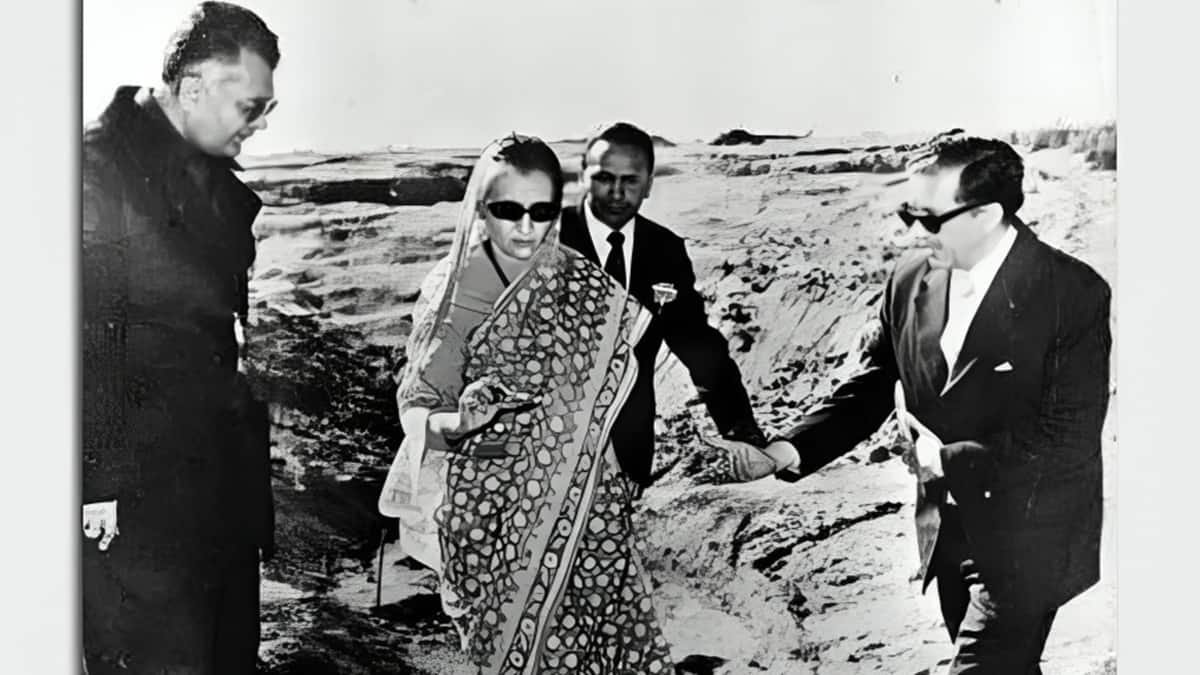
That assumption changed on May 18, 1974, when India conducted its first nuclear explosion at Pokhran in Rajasthan.
India- while doing the nuclear test- used plutonium that had been separated from spent fuel through a chemical process known as reprocessing. In simple terms, when uranium fuel is used inside a reactor, it produces plutonium as a by-product. Even after the fuel is considered “spent” and removed from the reactor, it still contains this plutonium mixed with highly radioactive materials.
Quick Reads
Can India weather another oil shock? Govt warns high crude could test fiscal health
Will Bangladesh attend the Brics Summit? Dhaka weighs diplomacy, politics and public opinion
Reprocessing is the chemical method used to separate the plutonium from the spent fuel.
India had produced the plutonium from the CIRUS research reactor, supplied under peaceful cooperation arrangements involving Canada and heavy water supplied by the United States.
India described the 1974 explosion as a “peaceful nuclear explosion,” but many countries viewed it as proof that civilian nuclear technology could provide a pathway to developing nuclear weapons. This led Canada and the US to reassess their nuclear cooperation policies, while international export controls became significantly stricter.
The lesson that changed global nuclear policy
The biggest lesson was not simply that India had tested a nuclear device. It was that material considered part of the civilian nuclear fuel cycle could also become the foundation of a weapons programme.
In other words, nuclear waste was no longer seen as merely harmless leftover material. It was recognised as a potential weapons stockpile in disguise, if a country possessed the technology to separate plutonium from spent fuel.
Governments concluded that a nation did not necessarily need a secret uranium enrichment programme to move towards nuclear weapons. Access to civilian reactors and reprocessing capabilities could also provide the necessary fissile material.
Why the world became more cautious
India’s 1974 test accelerated major changes in global nuclear governance.
Countries supplying nuclear technology became far more cautious about exporting reactors, fuel and sensitive reprocessing equipment. New safeguards were introduced under the International Atomic Energy Agency (IAEA) to monitor nuclear material more closely and ensure that civilian programmes were not diverted for military purposes.
The test also directly contributed to the creation of the Nuclear Suppliers Group (NSG) in 1975. The grouping was established by major nuclear-exporting countries to strengthen export controls and prevent civilian nuclear cooperation from inadvertently aiding weapons programmes. Today, the NSG remains one of the central pillars of the global nuclear non-proliferation architecture.
Why this matters right now
Barrett’s observation reflects a lesson that has endured for more than five decades.
Before 1974, nuclear waste management and nuclear weapons proliferation were often discussed as separate policy areas. After India’s test, policymakers increasingly viewed them as interconnected.
Every decision about storing, transporting or reprocessing spent nuclear fuel now carried not only environmental and safety implications but also strategic and security consequences.
More than 50 years after Operation Smiling Buddha, the lesson remains embedded in international nuclear policy: in the nuclear age, there is no such thing as “just waste.”