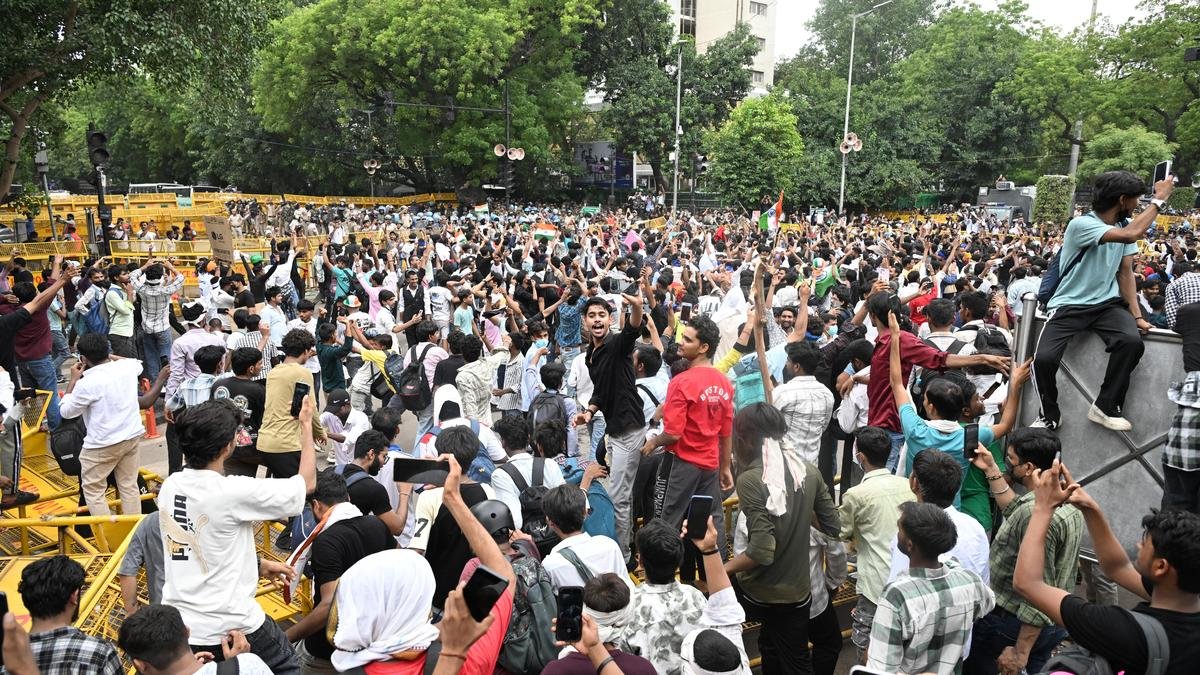
Within hours of the Supreme Court refusing on Monday (August 31, 2026) to halt a protest march announced by the Cockroach Janta Party (CJP) in central Delhi ahead of the BRICS Summit, the Delhi Police moved an urgent plea to quash First Information Reports (FIRs) registered against students and youths who participated in the NEET-UG paper leak protests.
Days before the BRICS Summit on September 12-13, the CJP decided to hit the streets again on September 5, citing the Centre’s failure to live up to its assurances, including the immediate withdrawal of FIRs against student protesters.
Earlier in the day, a three-judge Bench headed by Chief Justice of India Surya Kant found no “compelling circumstance” to interfere with CJP’s plans for a protest march.
AISA backs CJP's September 5 Delhi march; seeks withdrawal of FIRs, probe into pellet firing In the afternoon, as the Bench was preparing to rise for the day, Solicitor General Tushar Mehta orally mentioned an application filed by the Delhi Police urging the apex court to invoke Article 142 of the Constitution to quash the FIRs.
Mr.
Mehta pushed for a hearing on September 1 itself.
The Delhi Police said it “no longer wished” to pursue the FIRs registered across various police stations in central Delhi, from Barakhamba Road to Parliament Street to Connaught Place, against students and protesters following the crackdown on July 20.
These FIRs had arraigned charges of rioting, attempt to murder, and damage to public property against protesters.
The police expressed willingness to close any other FIRs which were not mentioned in the application.
They sought the court’s permission to file a “fresh, specific” FIRs only against 2,873 individuals with criminal antecedents, who were reported to be present at the NEET-UG protest site.
Chief Justice Kant agreed to list the application on September 1, remarking, “If parties are reconciling, we have no difficulties.” The CJI Bench’s refusal earlier in the day to intervene came in separate pleas filed by a retired Delhi Police officer, Rajender Singh, and another, who had objected to the announcement of the September 5 protest march.
Appearing for the petitioners, advocate Syed Rizwan Ahmed said that, to the best of his knowledge, the CJP had not sought permission from either the police or the courts; the decision to march had been announced on social media.
National interest would be served better if the CJP postponed the march by another 10 days, to September 15, he said.
“International dignitaries are coming to the capital on September 12 and 13.
What happened at the AI Summit recently?
People stripped and danced… Can’t the CJP wait for 10 days, till September 15, to allow the BRICS Summit to be held unhindered?” Mr.
Ahmed said.
“There are no compelling circumstances for us to presume that anything wrong would happen.
Everybody will conduct themselves in a peaceful, lawful and reasonable manner… It is the responsibility of the Union government and the Delhi Police to maintain law and order.
They will say what is illegal or permissive,” the CJI responded.
The court expected both sides, those who wish to march, and the police, to respect and honour the laws of the land, the Chief Justice said.
“Everybody should follow the law, the regulatory measures, and respect each others’ rights,” Chief Justice Kant observed orally.
The court instructed Mr.
Ahmed to provide the Solicitor General’s office with a copy of his application.
The Bench said it would tag the application with the main batch of petitions on the NEET-UG protests, scheduled to be listed on September 10.
It gave the counsel liberty to mention in case of any urgency in the interregnum.
Ahmed stridently urged the court to allow him to bring up the application on September 3, ahead of the proposed CJP march.
He asked, repeatedly, whether “the capital can be exposed to such anarchy at the doors of the BRICS Summit.
They (the protesters) have tasted blood… History may not forgive leniency in this situation”.
However, the Chief Justice merely asked Mr.
Ahmed to persuade the government and the Delhi Police.
“It is their duty to maintain law and order,” Chief Justice Kant said.