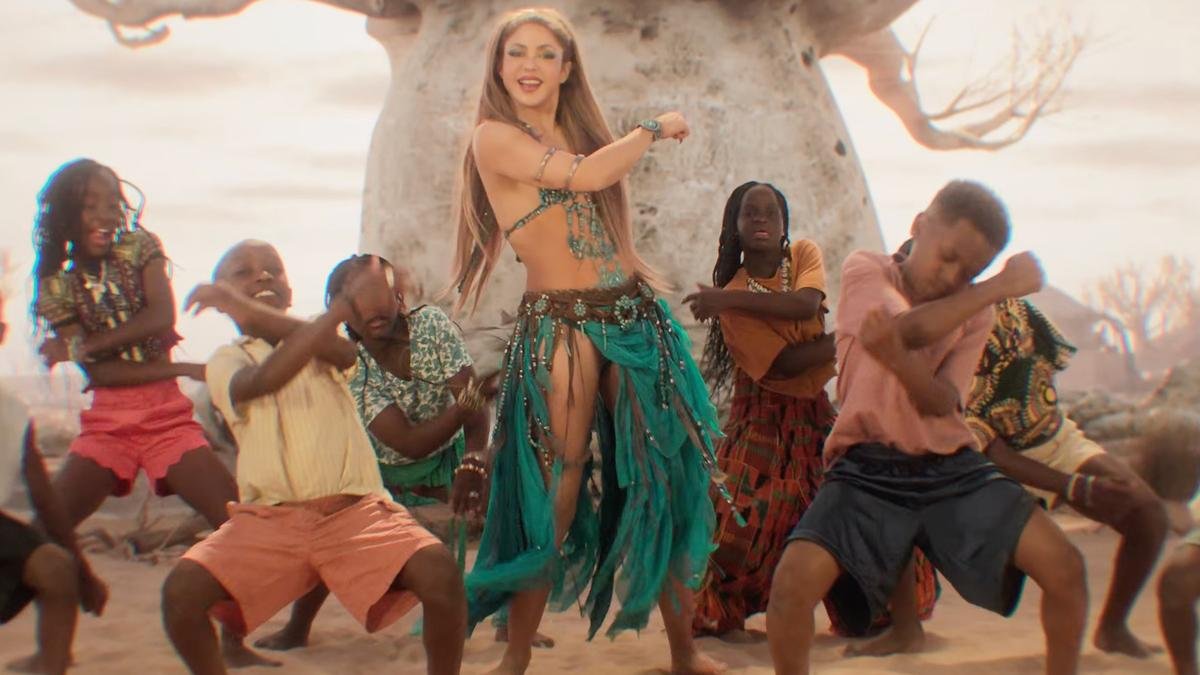
A group of children from Kampala will stand at the centre of MetLife Stadium on July 19, and the woman beside them will look entirely at home. That image, equal parts improbable and inevitable, tells you almost everything about Shakira. When the 2026 World Cup final stages the first Super Bowl-style halftime show in the tournament’s history, she will headline it, and she will not arrive alone. She has invited Uganda’s Ghetto Kids to dance with her before the largest audience football can summon. The children have already appeared in the video for her song ‘Dai Dai’, the official anthem of the 2026 tournament.
No artiste is more bound to the sound of the World Cup than Shakira, and the bond was forged in a single summer. In 2010, ‘Waka Waka (This Time for Africa)’ became the actual pulse of a tournament, a chant that travelled from Johannesburg stadiums into living rooms where nobody spoke Spanish and everybody knew the words. It is still among the best-selling World Cup songs ever recorded. What gave it weight was the grace of the gesture. She built it on an African melody, performed it with the South African band Freshlyground, and handed the moment back to the place that lent it.

Singer Shakira performs during the opening ceremony of the World Cup | Photo Credit: AP
Consider the symmetry of what comes next. The Ghetto Kids were founded by Dauda Kavuma on the streets of Katwe, one of Kampala’s poorest quarters, and they turned scarcity into something joyful and ungovernable. Over a decade they danced into a French Montana music video and onto the stages of Britain’s Got Talent and America’s Got Talent. Now Shakira is pulling them onto her stage. The woman who once gave Africa its World Cup anthem is handing a group of African children the spotlight, and the circle she opened in 2010 quietly closes. This is the throughline I keep returning to with her: she is forever enlarging the moment to make room for others in it.
To understand why that instinct feels so natural, it helps to remember where she comes from. Born in Barranquilla in 1977 to a Colombian mother and a father of Lebanese descent, she turned that inheritance into the music itself. The hip movement the whole world now imitates began as an Arabic dance she learned as a child. The crossover that followed produced numbers that are difficult to overstate. She is the best-selling Latin female artiste of all time, the first Colombian to win a Grammy, and the holder of four Grammys and fifteen Latin Grammys. ‘Laundry Service’ made her a global name without asking her to abandon the strangeness that made her interesting, and in 2020 she stood beside Jennifer Lopez at the Super Bowl and reminded sixty thousand people that two Latina women could own the biggest stage in American television. Through ‘Hips don’t lie’, ‘She wolf’, and that voice which trembles and refuses to behave, she never asked the world to meet her halfway. She assumed it would come along.
There is another side of her that rarely gets highlighted but explains the rest. Long before the Ghetto Kids, Shakira built the Pies Descalzos Foundation, named after one of her own albums, to fund schools and nutrition for children in the poorest corners of Colombia. Philanthropy for her has never been a press release. It is the same impulse as the music: a platform is only worth having if you can pull others onto it.
Her most recent chapter is also her most exposed. After a public separation and a few hard years, she returned with Las Mujeres Ya No Lloran, an album that turned heartbreak into something closer to resolve and won Best Latin Pop Album at the 2025 Grammys. The moments people remember from the tour that followed are rarely the pyrotechnics. They are the nights her sons, Milan and Sasha, walked out beside her in matching suits and sang their own small solos while she watched with undisguised pride. She folds her children into her work the way she folds in everything, openly and without apology.
That instinct is the real subject here. When she stands in that stadium this summer, the song will belong to the kids from Katwe finding their footing in front of a billion people, and to everyone watching them realise they were invited. That has always been the trick of her music: she makes the biggest possible stage feel like it has room for one more.
View this post on InstagramA post shared by Unitel Bolivia (@unitel_bolivia)
A post shared by Unitel Bolivia (@unitel_bolivia)