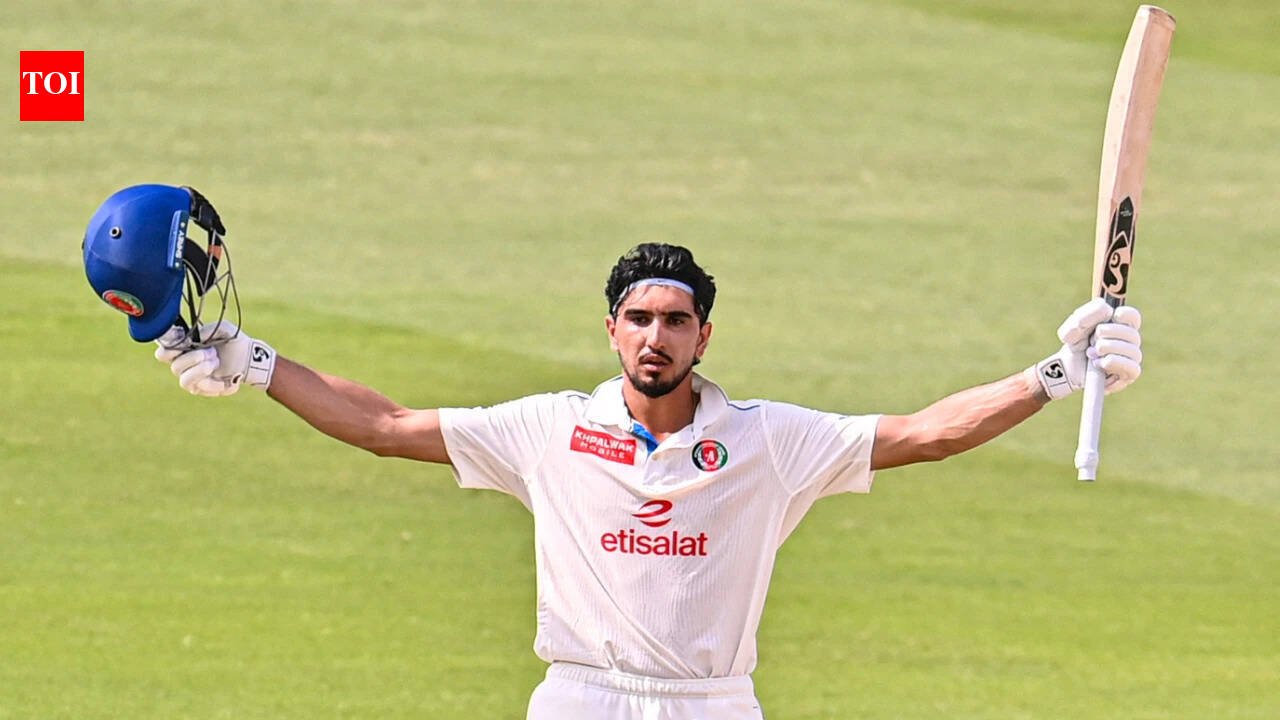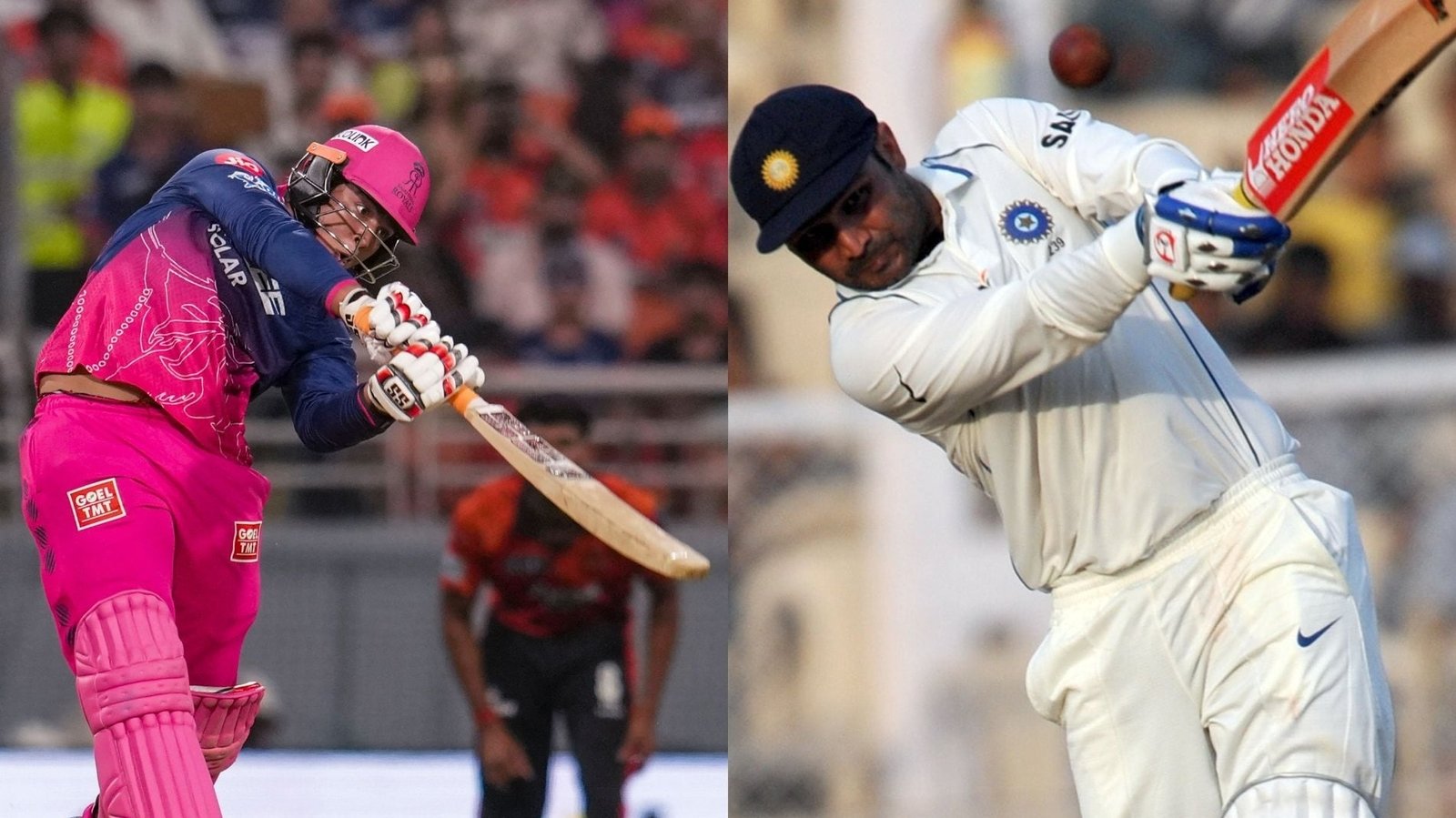
Virender Sehwag and Vaibhav Sooryavanshi: Aggressive batters setting new standards Sehwag changed Test batting with his fearless scoring, while Sooryavanshi has taken aggression to new heights in the modern T20 era.
Updated on: Oct 13, 2026, 21:16:53 IST By Probuddha Bhattacharjee Prefer HTon Google Share via Copy link One must look back to the 2008 Chennai Test.
South Africa had piled up 540 runs, and India needed to show resolve in response.
Virender Sehwag, recalled to the Test side in the preceding series in Australia and having made a statement 151, walked out to open the innings for India.
He decided to approach the innings in his typically flashy way.
He began the third day on 52 and, by stumps, had 309 to his name.
He reached his triple-century off just 278 balls.
Sehwag changed the complexion of the match and put India in the driver’s seat.
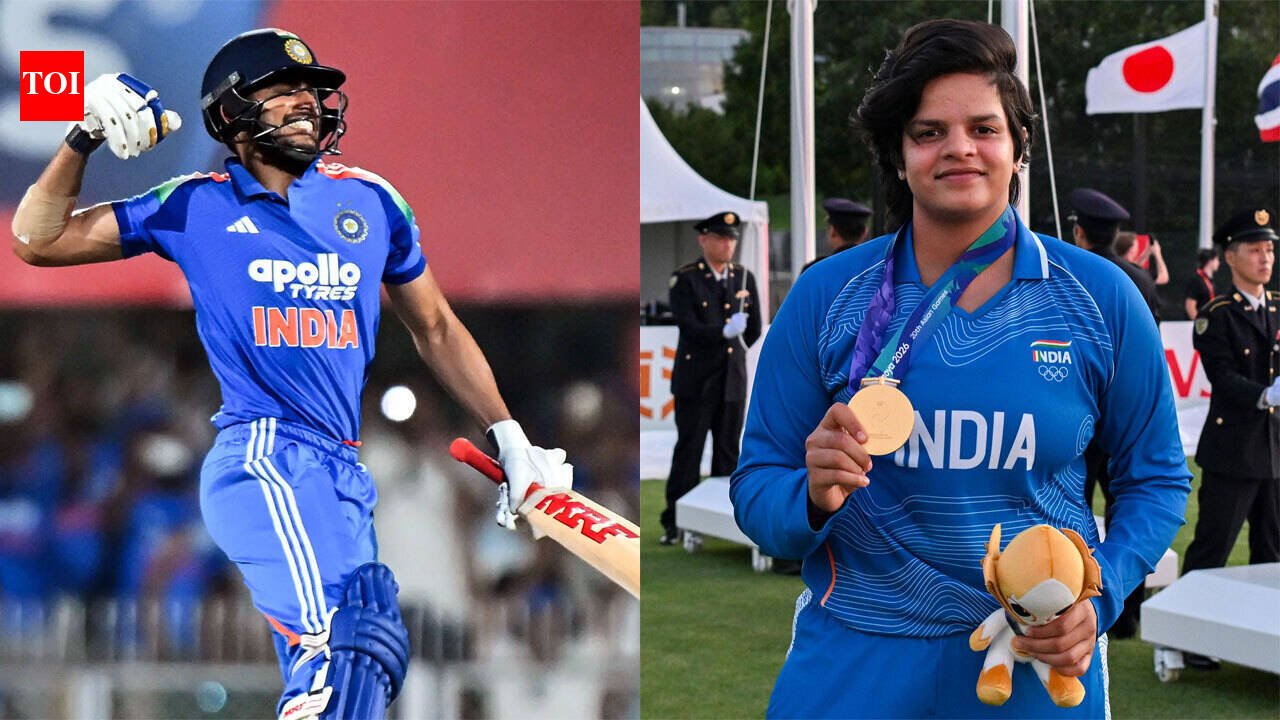
Vaibhav Sooryavanshi for Rajasthan Royals, Virender Sehwag for India. (X Images) It was a period when batters preferred to take their time before upping their scoring rate.
However, the audacity to play his natural, aggressive game, irrespective of the situation, made Sehwag stand apart in that era.
Probably, this is why he sees something similar in Vaibhav Sooryavanshi.
“Sooryavanshi is in his prime, and his thinking is somewhat similar to mine, that of hitting right from the first ball,” he said recently at a PHD Chamber of Commerce and Industry event.
While Sehwag spoke about the general attacking instinct, the numbers suggest a stronger resemblance, although Sooryavanshi is only getting started, unlike the man who finished with 104 Tests.
Times have changed, and Sooryavanshi is developing in an era where batting aggression is no longer met with surprise.
However, even in these times, Sooryavanshi has made one, and all admire the way he approaches his batting.
The courage to play cricket in a style that makes even modern batters look second to him has mesmerised everyone.
To measure this, a comparison of Sehwag's Test and ODI performances from 2001 to 2012 was made against those of nine prominent players in each format.
Only what those players did during the same years was considered.
The selection was made to include the most intimidating hitters and the prolific run-scorers of the period.
For Sooryavanshi, all 34 players who scored at least 300 runs in IPL 2026 were picked.
Sehwag's numbers unusual even for an aggressive opener Between 2001 and 2012, Sehwag scored 8,559 Test runs, averaging 50.05.
His strike rate was 82.39.
The mean strike rate of the other nine batters was 57.95.
That makes Sehwag 42.2% faster than his closest contemporaries.
Across 150 deliveries, he scored roughly 37 runs more.
Matthew Hayden was one of the most intimidating openers of that period.
He scored 8,097 runs at an average of 53.98.
His strike rate was 61.20.
Sehwag scored almost 500 runs more, and at a rate 34.6% faster.
Virender Sehwag vs other batters in the same period. (HT Digital) Adam Gilchrist is an exception in this group, as he was the only batter to score faster than Sehwag.
He scored at a strike rate of 83.46 in the same years.
Gilchrist accumulated 4,787 runs batting down the order.
While the Australian was faster than him, Sehwag had greater volume.
Among the nine peers selected, no one scored more runs than him while maintaining a higher strike rate.
The ODIs bring out another aspect of Sehwag's batting.
Shahid Afridi scored runs at a faster rate than Sehwag.
While Sehwag had a strike rate of 104.61, Afridi scored at 125.95.
But Sehwag had more runs, scoring 8,222 to the Pakistani's 4,402.
Batters like Sachin Tendulkar and Ricky Ponting showed better consistency, though their strike rates were 86.41 and 83.81, respectively.
This shows that Sehwag hovered between a frantic hitter and a steady accumulator.
However, he never fully accepted either role.
Virender Sehwag vs other batters in the same era. (HT Digital) Sooryavanshi doing it in an era that already celebrates aggression Batting has evolved a lot since Sehwag’s retirement.
In the early 2000s, most batters liked to spend time before increasing their scoring rate.
However, in modern times, especially in T20 cricket, batters are hardly allowed time.
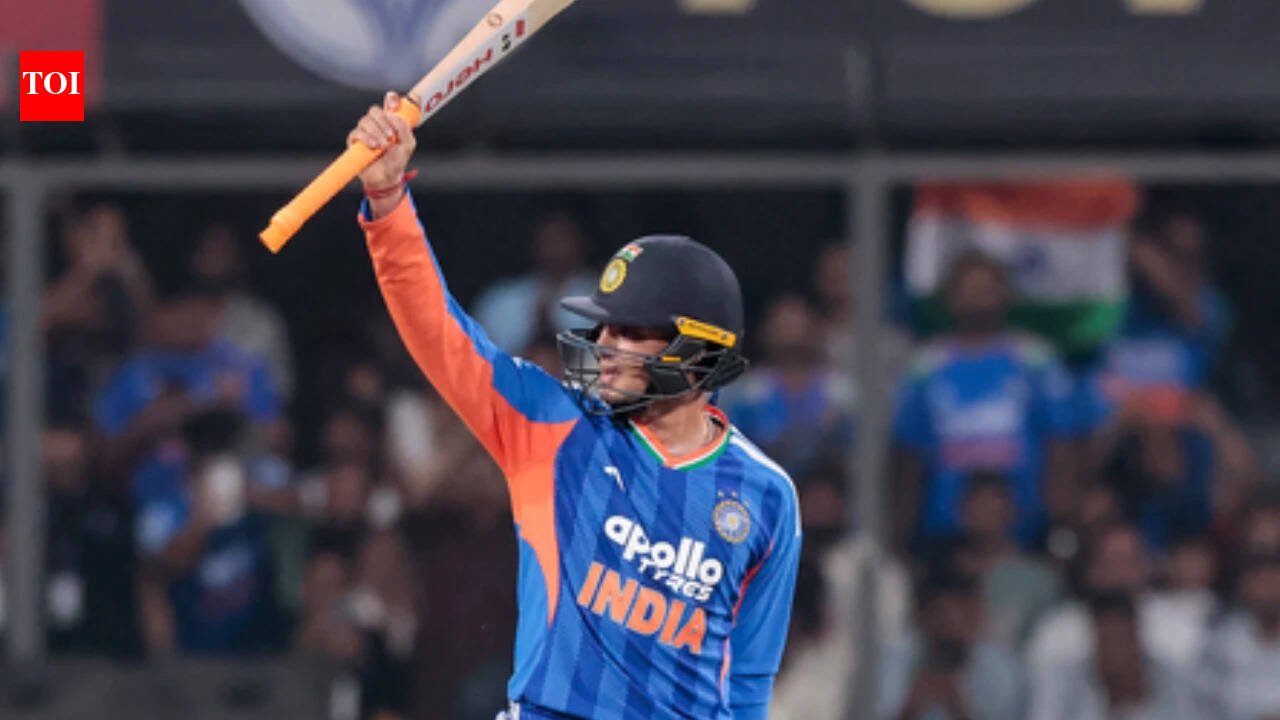
Sooryavanshi’s IPL 2026 was an example of extreme aggression even by modern standards.
He scored 776 runs in 16 matches, averaging 48.50 and at a strike rate of 237.30.
The other 33 batters with at least 300 runs had a mean strike rate of 165.77.
Sooryavanshi was scoring 43.2% faster.
His strike rate stood 3.4 standard deviations above that average.
Vaibhav Sooryavanshi in IPL 2026. (HT Digital) Shubman Gill finished with 732 runs at 163.03.
Abhishek Sharma made 563 at 204.73.
Neither came close to Sooryavanshi in either department.
In fact, the teenager finished ahead of every qualifying player in runs as well as strike rate.
He struck 63 fours and 72 sixes from just 327 deliveries.
That is one boundary every 2.42 balls, against approximately 4.14 for the other batters collectively.
Of his 776 runs, 684 came in boundaries.
The numbers show that Sehwag’s observation has substance.
However, the biggest takeaway is that both batters brought something new to the art of batting.