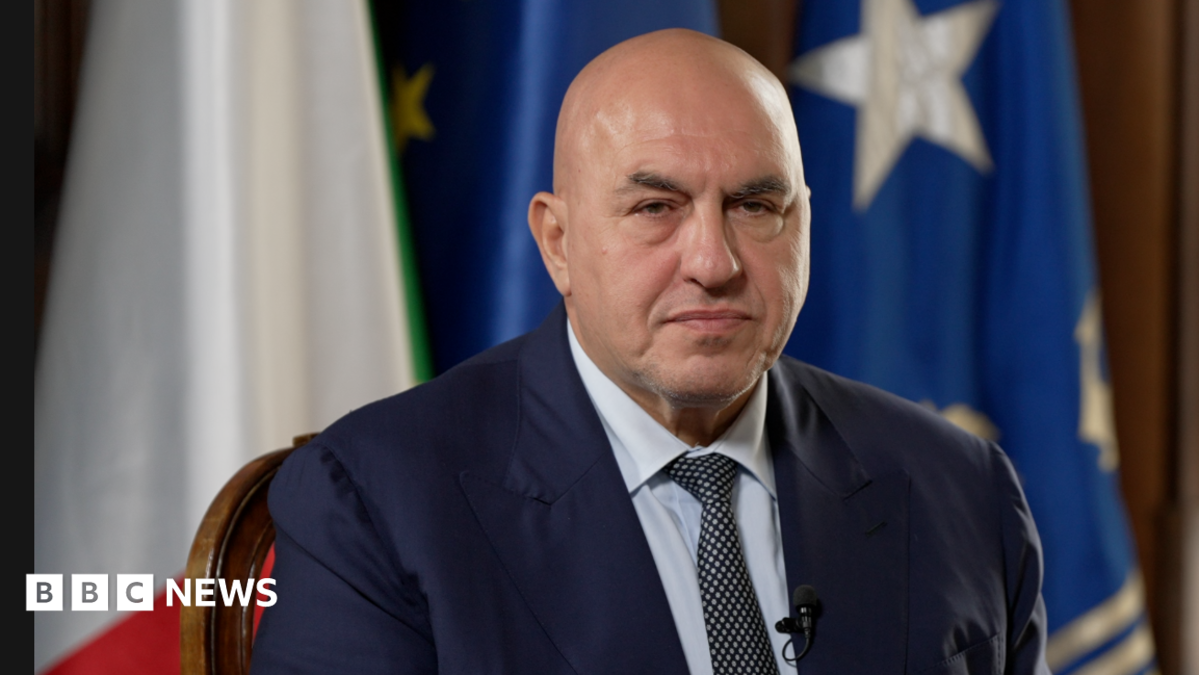
Figure caption, Watch: Europe preparing for 'possibility of madness' from Russia, says Italy's defence minister BySarah RainsfordEastern and Southern Europe correspondent, Reporting fromRome Published 17 October 2026, 00:54 BST Italy's defence minister has said it was a "complete mistake, a major mistake" for the US to limit access to satellite systems and intelligence used by Ukraine to defend itself against Russian attacks.
Guido Crosetto warned in a BBC interview that any such move by US President Donald Trump's administration "makes absolutely no sense" and risked prolonging Russia's full-scale invasion rather than helping to bring peace.
Trump has denied asking for satellite access to be suspended.
Crosetto's comments continue Italy's sharpening criticism of the US.
Earlier this week, Prime Minister Giorgia Meloni called Trump's deal to buy diesel from Russia a "very risky choice" and said it would "grant Russia legitimacy" as it bombed cities in Ukraine.
Trump agreed the deal with Russian President Vladimir Putin, blaming Kyiv's own attacks on Russian refineries for rising fuel prices.
Meloni, once considered so close to the US president she was dubbed a "Trump whisperer", said the move ran counter to efforts to bring Putin to the negotiating table.
"Peace will come when Putin is convinced there is a stalemate, that he cannot advance any further," her defence minister told the BBC at his ministry building in Rome.
Crosetto was a co-founder of Meloni's hard-right Fratelli d'Italia party, which has led a right-wing government coalition since 2022, shortly after the start of Russia's full-scale war.
"If [Putin] sees weakness on the Ukrainian side – and if the US deprives Ukraine of resources, that creates weakness – then he will believe he can win.
So he will continue the war," Crosetto warned.
"I think that is completely wrong." Image source, Anadolu via Getty Images Image caption, Italy's prime minister has become a close ally of Ukraine's Volodymyr Zelensky Despite widespread public scepticism, Meloni's Italian government has been a strong ally of Ukraine from the start, sending both military and humanitarian aid.
The specifics of those deliveries have always been classified.
Crosetto said that victory for Ukraine would be "a victory for peace, a victory for justice, a victory for international law".
He vowed that Italian military support would continue "for as long as this government is in place", though he warned that getting Italy's parliament to approve further deliveries would be "more difficult" as elections approached.
The vote has to take place by the end of 2027 and opinion polls currently put a new far-right party, Futuro Nazionale, ahead of all Meloni's coalition partners.
That party's leader, former general Roberto Vannacci, is openly sympathetic to Russia and opposes aiding Ukraine, arguing that Europe is wasting its money as Russia's military "continues to advance" on the ground.
At a recent event in Tuscany, he described himself as "neither pro-Putin nor pro-Russian" but "pro-Italian".
Crosetto brushed off questions about Vannacci, including on whether his views reflected those of many Italians, saying he had more "serious matters to deal with".
But, perhaps to underline the difference, he was unequivocal on Russia.
"When one state crosses another state's border with tanks, when it bombs hospitals and schools, kills civilians and bombs power plants, and has been doing so for four years, I can only describe that as evil," he said.
Zelensky says Ukraine has right to defend itself after Trump calls latest strikes a 'disgrace' Published 1 day ago Inside Ukrainian offensive pushing Russia back - with Starlink playing a key role Published 1 day ago Italians, like many Europeans, are seeing prices go up, driven by the high cost of energy.
During street protests in Rome on Friday, where firecrackers were thrown, secondary school students complained that resources were being diverted to arms instead of education.
Some chanted: "We want more classroom, not more bombs." In southern Italy, truckers have begun blocking roads complaining at the hike in fuel prices.
Polls here regularly show that a majority of Italians want an end to military aid for Ukraine.
One, conducted for the Ixè institute in September, put support for continuing to supply arms at just 18%.
There are many factors behind that, from a long-standing pacifist tradition to a history of strong business ties to Moscow.
Unlike Poland or the Baltic states, Italy feels physically distant from the danger, too.
But the defence minister also blamed an active campaign of disinformation by Moscow – targeting, he said, "certain political figures... and narratives to weaken the political climate against Russia".
"In some way they shift public opinion," the minister argued.
"It's very hard to explain to a citizen who's having trouble at the petrol pump that we can't give any concessions to Russia right now.
But that's the only way to defend the future of that very citizen who's complaining." Italy has not been targeted for major acts of sabotage, unlike other allies of Ukraine in Europe.
The minister said a fire at an arms depot outside Rome in August was not arson, but "human stupidity".
A report last month that Russia was planning to launch drone attacks at Italy, France and Spain from the container ships in the Mediterranean was not proven, Crosetto also told us.
But cyber-attacks, which he linked to Russia, were now routine - "there are hundreds every day" - and he believed Europe had been too weak in its response.
"You can't win a war... if you don't fight back," the minister said.