The Mecca defence pact: A new Sunni bloc or a strategic tool against India?
By locating the agreement in Mecca and framing it around Sunni-majority states, the bloc can be interpreted as a religiously infused security grouping.
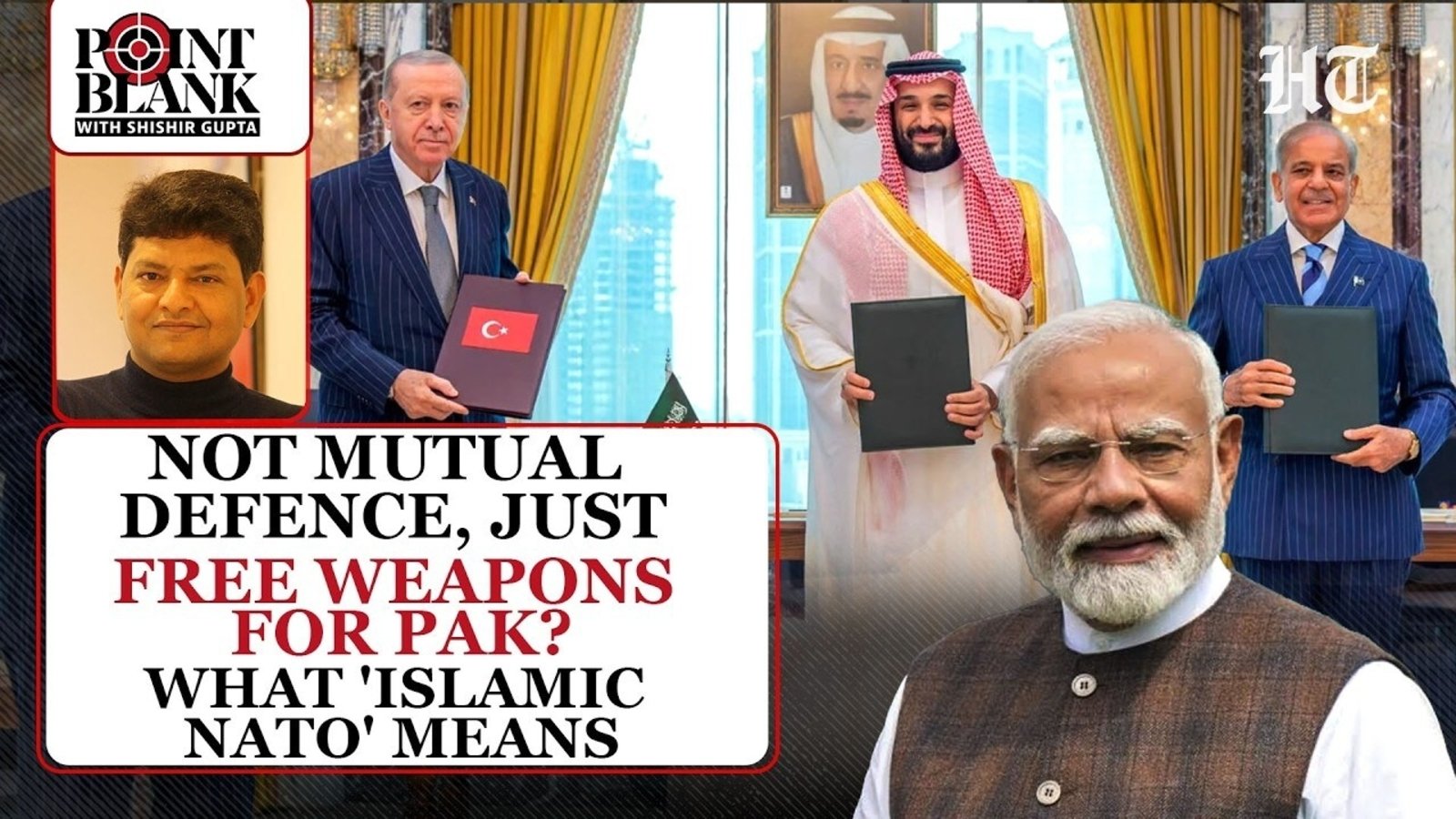
Updated on: Aug 10, 2026, 17:58:50 IST By Shishir Gupta Prefer HTon Google Share via Copy link The proposed Mecca Joint Defence Agreement between Saudi Arabia, Turkey and Pakistan has sparked a major debate across West Asia and South Asia.
Presented as a NATO-style mutual-defence arrangement - where an attack on one member would be regarded as an attack on all - the pact raises questions far beyond its formal language.
Is it a regional hedge against Iran?
Is it an attempt to build a wider Sunni security architecture?
Or, as Hindustan Times Executive Editor Shishir Gupta argues, could its most immediate strategic consequence be to strengthen Pakistan’s military position against India?
Hindustan Times Executive Editor Shishir Gupta argues, could its most immediate strategic consequence be to strengthen Pakistan’s military position against India?
In a discussion with senior anchor Aayesha Varma, Gupta described the arrangement as carrying three overlapping meanings: political, military and religious.
Yet he also cautioned against accepting its public description at face value.
The true significance of the pact, he argued, will depend not on declarations made in Mecca but on how - or whether - its members act when confronted by an actual military crisis.
A Pact With Three Dimensions On the surface, the agreement appears to mirror NATO’s Article 5 principle of collective defence.
Turkey, already a NATO member, brings military-industrial capability and diplomatic weight; Saudi Arabia brings financial resources and custodianship of Islam’s holiest sites; Pakistan brings one of the Muslim world’s largest armed forces and, crucially, nuclear weapons.
Gupta’s reading is that this combination gives the pact an unusually powerful symbolic profile.
Potential future participants could include Arab states such as Egypt, Kuwait, Bahrain and Qatar, though any expansion would depend on their own regional calculations.
The symbolism matters because West Asian security remains shaped by the Sunni-Shia divide, particularly the rivalry between Saudi Arabia and Iran.
Iran’s extensive relationships with groups such as Hezbollah in Lebanon, the Houthis in Yemen, Hamas in Gaza and Iraqi Shia militias have made it an influential regional actor even when it has faced direct pressure from the United States and Israel.
A Sunni-oriented grouping could therefore be seen as a response to Iran’s regional reach.
But Gupta urges caution.
He argues that it is too simplistic to conclude that the pact is primarily or exclusively directed at Iran.
In the Middle East, alliances are often ambiguous, transactional and dependent on the particular crisis at hand.
The Test of Collective Defence The central question is whether Saudi Arabia, Turkey and Pakistan would actually fight for each other.
Mutual-defence commitments are credible only when they impose real costs on their members.
That is why NATO’s Article 5 has weight: it rests on decades of institutional coordination, integrated military planning and the overwhelming capability of the United States.
The Mecca arrangement, by contrast, faces immediate practical questions.
If the Houthis attacked Saudi Arabia or disrupted shipping near Bab al-Mandab, would Turkey deploy forces against them?
Would Pakistan take military action against Iran if an Iranian-linked group targeted Saudi interests?
If Pakistan faced a military confrontation involving India, would Saudi Arabia and Turkey be prepared to intervene directly?
Gupta argues that such questions cannot yet be answered.
He points to earlier instances in which regional partners offered limited support to Saudi Arabia after attacks, rather than engaging in decisive military action.
A pact may generate political messaging and weapons cooperation without becoming a fully operational alliance.
This gap between rhetoric and action is vital.
Defence pacts do not automatically create common command structures, shared operational plans, agreed rules of engagement or the political will to risk war.
In practice, Saudi Arabia’s security priorities differ from Turkey’s, while Pakistan must continuously balance relations with Saudi Arabia, China, the United States, Iran and its immediate South Asian environment.
Why India Should Watch Closely For India, the core concern is not necessarily that Turkey or Saudi Arabia would join Pakistan in a future conflict.
Instead, Gupta suggests that the pact could give Pakistan greater access to money, defence supplies, maintenance support and military technology.
Turkey has emerged as a prominent exporter of armed drones, naval systems and other defence equipment.
Its defence relationship with Pakistan has included cooperation in areas such as unmanned systems and submarine modernisation.
China also remains Pakistan’s most important military supplier.
A Saudi-Turkish-Pakistani framework could potentially allow Pakistan to rebuild inventories, acquire new platforms and expand its missile or drone capabilities.
That concern is especially acute in the wake of heightened India-Pakistan tensions and the continuing risk of terrorist attacks.
Gupta’s argument is that Pakistan could benefit from the pact even if its members never invoke a collective-defence clause.
Financial backing, defence-industrial access and political coordination would themselves alter the regional balance.
Saudi Arabia’s position is more complicated.
India has cultivated strong political, economic and security ties with Riyadh, while New Delhi also maintains a major strategic partnership with the United Arab Emirates.
According to Gupta, India has communicated concerns to Saudi Arabia at high levels, and Saudi officials have indicated that any such alliance is not aimed at India.
Nevertheless, India is likely to assess the pact through the prism of Pakistan’s involvement and Turkey’s consistently pro-Pakistan posture.
Turkey’s Balancing Problem Turkey’s participation introduces another layer of complexity.
As a NATO member, Ankara is already bound by the alliance’s mutual-defence framework.
However, NATO’s commitment applies to attacks on NATO territory and members; it does not automatically extend to Turkey’s bilateral or multilateral security relationships with non-NATO states.
Therefore, an attack on Pakistan would not automatically trigger NATO intervention simply because Turkey is associated with a separate defence pact involving Islamabad.
Gupta is right to identify this as a potential source of confusion.
Any attempt to portray the Mecca arrangement as a backdoor route to NATO protection for Pakistan would be legally and politically implausible.
Turkey’s wider regional ambitions may also explain its interest.
Ankara has sought to expand diplomatic, commercial and military influence across West Asia, the Gulf, Africa and Central Asia.
A closer relationship with Saudi Arabia and Pakistan could strengthen Turkey’s claim to leadership in parts of the Sunni Muslim world.
Yet the same ambition could produce friction, particularly with the UAE, Israel and other states that have their own regional coalitions and rivalries.
Nuclear Risks and Counter-Alignments Pakistan’s nuclear status makes this emerging arrangement more consequential than a conventional defence partnership.
Gupta highlights Pakistan’s record of nuclear proliferation, particularly the legacy of the A.Q.
Khan network, as a source of international concern.
Any deepened strategic engagement between nuclear-armed Pakistan and Saudi Arabia will inevitably be scrutinised, even if there is no evidence that the pact itself involves nuclear cooperation.
The wider Middle East already contains multiple layers of deterrence and insecurity: Israel’s undeclared nuclear arsenal, Iran’s nuclear ambitions, Saudi Arabia’s pursuit of civilian nuclear cooperation, and the possibility of renewed US-Iran confrontation.
Adding Pakistan - an established nuclear weapons state with close defence ties to China - could make an already volatile region more unpredictable.
At the same time, counter-alignments are likely.
India’s expanding partnerships with the UAE, Saudi Arabia, Iran, France, the United States and other powers offer New Delhi diplomatic and strategic options.
India is unlikely to respond by creating a religiously defined alliance of its own.
Instead, it will probably focus on strengthening deterrence, intelligence, military readiness, defence production and regional partnerships.
Ultimately, the Mecca Defence Pact is best understood as an emerging geopolitical signal rather than a proven military alliance.
Its language may be ambitious, but its credibility will be established only when its members face a real crisis.
Until then, India and the wider region will watch closely - not merely for what the pact says, but for what it enables Pakistan, Turkey and Saudi Arabia to do.