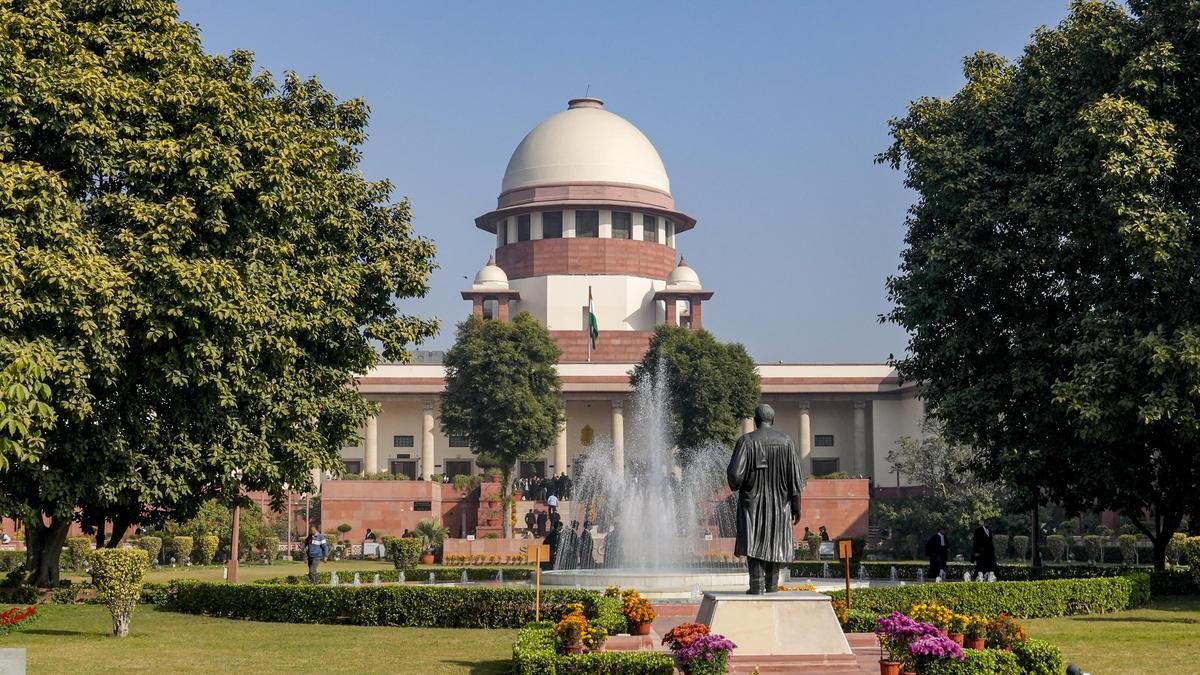
The Supreme Court on Monday (September 7, 2026) asked the Uttar PradeshPolice why they needed the digital footprint of Abhishek Upadhyay, an independent journalist who flagged the alleged misappropriation of donations to the Ayodhya Ram temple, in order to investigate a road-rage case registered against him.
Content creator who reported on Ram Temple donations theft, corruption in Uttar Pradesh alleges harassment “In a road-rage case, why would you require the digital footprints of the accused?” a three-judge Bench headed by Chief Justice of India (CJI) Surya Kant asked.
The Bench, also comprising Justices Joymalya Bagchi and V.
Mohana, directed the Ghaziabad Police Commissioner to file an affidavit detailing the information sought from social media platform X for investigating the first information report (FIR) registered against Mr.
Upadhyay.
U.P.
Police seeking digital footprint to dig out his Ram Temple donation case sources “The Commissioner of Ghaziabad may file an affidavit clarifying what kind of information is required to be furnished by X, formerly Twitter, for the purpose of investigation of the FIR or any other FIR registered earlier against the petitioner.
However, no such information shall be brought into the public domain until further orders,” the Bench said.
It also directed Mr.
Upadhyay to cooperate with the police in the probe.
The plea The top court was hearing a plea filed by Mr.
Upadhyay, seeking the quashing of the road-rage FIR or, alternatively, the transfer of the probe to the Central Bureau of Investigation (CBI).
He alleged that the FIR was based on fabricated allegations and was registered to harass him over his journalistic work.
Mr.
Upadhyay subsequently moved an application before the Supreme Court, claiming that the Uttar Pradesh Police were seeking details of his digital activity dating back to June 1, 2026, in an attempt to identify his sources.
Police from taking coercive action against journalist who flagged Ram Temple misappropriations On Monday (Septemer 7, 2026), senior advocate Pradeep Rai, appearing for Mr.
Upadhyay, argued that investigating agencies must follow due process while seeking an accused’s digital information.
He said the Uttar Pradesh Police sought data from social media intermediaries, including YouTube and X, covering a period well beyond the date of the alleged offence.
This included Mr.
Upadhyay’s International Mobile Equipment Identity (IMEI) number, which uniquely identifies a mobile device.
“The whole problem is that investigating agencies give the impression that they are more loyal than the king...
They have written to X seeking details, including my IMEI number, not only for a day but for the last year,” Mr.
Rai submitted.
New guidelines sought The senior counsel urged the Bench to frame guidelines on the extent of digital information that investigating agencies could seek, while safeguarding an accused person’s right to privacy and a fair trial.
Referring to the safeguards laid down by the Supreme Court for arrested persons in D.K.
Basu vs.
State of West Bengal (1996), he argued that similar protections were needed to govern investigations in the digital age.
“This is an opportunity after D.K.
Basu for proper guidelines to be issued...
Digital rights have to be protected.
A majority of information is now traced through the Internet,” Mr.
Acknowledging the concerns, the Chief Justice said technological advances had posed new challenges for criminal investigations and that a balance needed to be struck between safeguarding the rights of an accused and enabling investigating agencies to conduct an effective probe.
“The advancement of technology raises very complicated challenges...
If investigating agencies don’t employ scientific methods of investigation, the courts will say the investigation is very poor...
The victim will also accuse them of not investigating and say their rights are being violated...
Some balance has to be drawn somewhere,” the Chief Justice said.
‘Sweeping allegations’ The counsel appearing for the Uttar Pradesh Police said he would seek instructions on why digital information of this nature was required for the investigation.
He, however, questioned the “sweeping allegations” made by Mr.
Upadhyay against an engineer associated with the construction of the Ram temple.
“He is talking about regulation of the police.
What about regulation of this kind of journalism?
Please see the nature of the allegations this gentleman makes that an engineer had received a 40% commission in connection with the temple’s construction.
These kinds of sweeping statements... are actually tainting and blemishing people without any evidence on record.
Is that fair?” he asked.
The counsel, however, assured the court that if no incriminating material was found against Mr.
Upadhyay, the police would file a closure report.
The Chief Justice then pointed out that accessing confidential information of an accused could infringe upon their right to privacy, but said it may be permitted if specific information was required to take an investigation to its logical conclusion.
“You file an affidavit [explaining] how information from X is required and what kind of information is required for the purpose of taking the investigation to its logical conclusion,” the Chief Justice told the counsel appearing for the police authorities.
Earlier, the Supreme Court had directed the Ghaziabad Police to provide Mr.
Upadhyay with a copy of the FIR and CCTV footage relating to the road-rage incident.
It had also protected him from arrest and allowed him to approach the jurisdictional High Court for further relief.
The FIR alleges that Mr.
Upadhyay’s SUV hit a two-wheeler, following which he allegedly hurled caste-based abuses at the scooter rider.