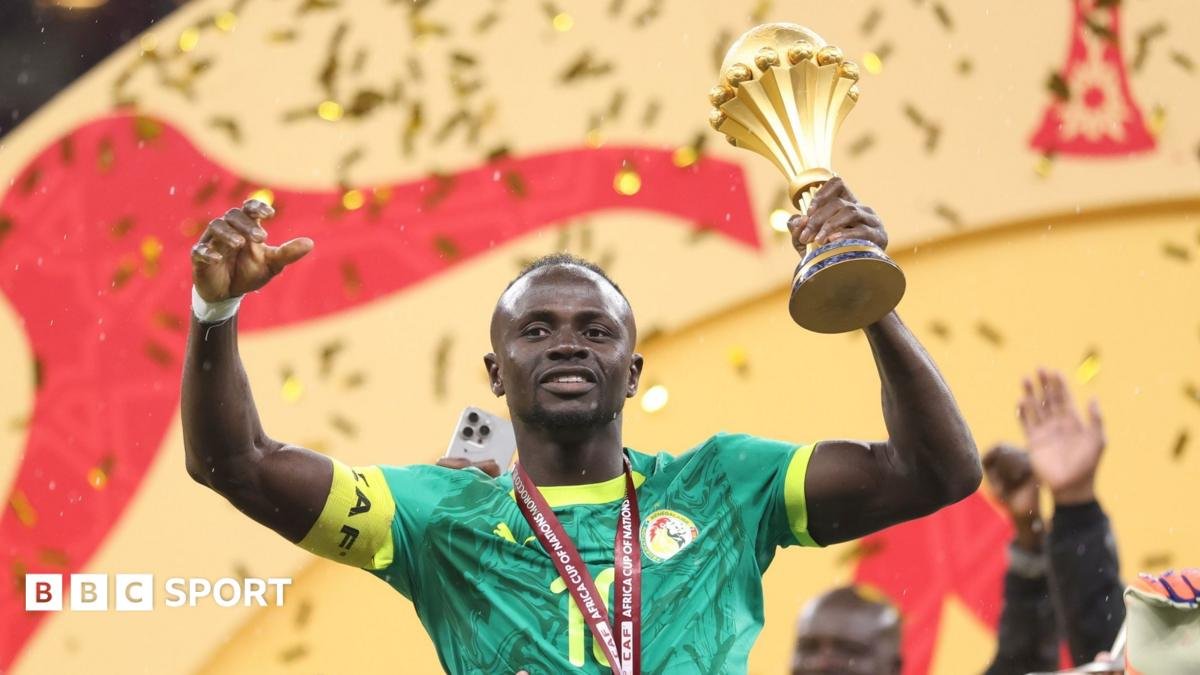
Image source, Getty Images Image caption, Sadio Mane's Senegal have been confirmed as Afcon 2025 winners following their appeal to the Court of Arbitration for Sport, giving the Teranga Lions a second continental title ByRob Stevens, BBC Sport Africa and Ian Williams, BBC Sport Africa Published 24 November 2026, 14:26 GMT Updated 1 hour ago Senegal have been reinstated as winners of the 2025 Africa Cup of Nations after a ruling by the Court of Arbitration for Sport.
The court's award overturns a previous decision which had stripped the West Africans of the title they won on the pitch during a chaotic final against host nation Morocco in January.
With the game goalless, Senegal left the field of play in second-half stoppage time in protest at a penalty awarded against them.
The match in Rabat was delayed by over 15 minutes before Morocco's Brahim Diaz had his spot-kick saved.
Senegal then triumphed 1-0 after extra time, with Pape Gueye scoring the winner.
That result was overturned almost two months later when a Confederation of African Football (Caf) appeals board decreed the Teranga Lions had breached competition regulations by leaving the field of play after the penalty was awarded.
Senegal's football federation (FSF) subsequently appealed to the Court of Arbitration for Sport (Cas), sport's highest legal authority, with a three-man panel hearing its case behind closed doors in Lausanne on 8 October.
In a unanimous verdict, the Cas panel has effectively backed the decision by referee Jean-Jacques Ndala to restart the game after Senegal returned to the field and the match was played to a conclusion.
The result of the final stands and Senegal are now confirmed as Africa Cup of Nations (Afcon) 2025 winners.
A statement issued by Cas said the court considered that "the referee's decision to resume the match or to stop it fell definitively within his sole authority".
"By blowing his whistle to restart play, the referee considered that the conditions for resuming the match had been met - both teams were on the pitch again, and both expressed their willingness to resume." The FSF immediately reacted with a social media post featuring a picture of the side lifting the trophy in January captioned with the phrase "again and always champions of Africa".
"The FSF welcomes this ruling with deep satisfaction," it later said in a statement.
"This decision affirms, above all, the triumph of sporting fairness and reaffirms a fundamental principle: the true outcome of a match is determined exclusively on the field of play, under the protection of sports law." Meanwhile, Morocco's football federation (FRMF) expressed "surprise" at the ruling and added that it would "pursue all available legal avenues to challenge the decision".
Caf says it respects the Cas award and "will take all the necessary measures to implement it".
The full grounds for the decision will be published by Cas in due course unless the parties request confidentiality.
'Shameful' and 'terrible look' - the chaos that marred Afcon 2025 final Published 19 January 'The longest VAR check in history' - the fallout from shock Afcon decision Published 18 March Senegal's walk-off during the final in Rabat has already brought about a change in football's rules.
"The referee may sanction with a red card any player who leaves the field of play in protest at a referee's decision," said Ifab, the game's lawmaking body, in April.
"This new rule will also apply to any team official who incites players to leave the field of play.
A team that causes a match to be abandoned will, in principle, forfeit the match." Morocco and Senegal have both changed coach since the Afcon 2025 final and earlier this month secured their places at the 2027 edition of the tournament with two rounds of qualification remaining.
What happened in the Afcon final?
Image source, Getty Images Image caption, Referee Ndala was at the centre of the controversy during the Afcon final A tightly contested final between the continent's top-ranked sides produced two moments of controversy in second-half stoppage time, with referee Ndala at the centre of the drama.
First the Congolese official denied Senegal a near-certain goal, blowing his whistle for a challenge by Abdoulaye Seck on Morocco right-back Achraf Hakimi moments before Ismaila Sarr nodded in.
The free-kick looked soft, but the video assistant referee (VAR) was unable to get involved because Ndala had awarded the foul before the ball crossed the line.
Three minutes later came a flashpoint in the Senegal box, when El Hadji Malick Diouf tugged Morocco playmaker Diaz back before heading a corner clear.
Diaz vehemently claimed a penalty and Ndala eventually awarded a spot-kick after being sent to consult his pitchside monitor by the VAR.
Senegal coach Pape Thiaw called his players over to the touchline, and Thiaw subsequently headed down the tunnel to the changing room in protest against the decision - accompanied by several players.
They eventually returned, but over 15 minutes had elapsed since the award of the penalty by the time Real Madrid's Diaz failed to convert, with his Panenka-style attempt easily saved by goalkeeper Edouard Mendy.
Meanwhile, there was unrest inside the Prince Moulay Abdellah Stadium as a small contingent of Senegal supporters clashed with security staff.
The game went into extra time, with midfielder Gueye scoring the goal which settled the contest in Senegal's favour.
Off the pitch, another match involving disciplinary boards and lawyers would soon begin.
What was the fallout?
Image source, Getty Images Image caption, Brahim Diaz's penalty was saved by Edouard Mendy after Senegal's walk-off led to a delay of over 15 minutes before he was able to take the spot-kick Senegal celebrated their second continental title but the FRMF quickly lodged an appeal with Caf, arguing their opponents had breached Article 82 of Afcon regulations, which covers withdrawals.
It states that if a team "refuses to play or leaves the ground before the regular end of the match without the authorisation of the referee" it shall be "considered [the loser] and shall be eliminated for good from the current competition".
A disciplinary board from the continental game's governing body rejected the FRMF's appeal days after the final as it sanctioned and fined those found guilty of unsporting conduct during the match.
Yet in March, almost two months on from the final, a Caf appeals board ruled that Senegal had forfeited the match and awarded Morocco a 3-0 victory.
The FSF described the ruling as "unfair, unprecedented and unacceptable" and swiftly lodged its case with Cas.
The director general of the Switzerland-based court said arbitration proceedings would be conducted "as swiftly as possible", but it was over five months until all parties descended on Lausanne for a one-day hearing.
The Cas panel was led by Frenchman Gerald Simon, founder of the Sports Law Laboratory at the University of Burgundy and a Cas member for 23 years.
Both the FRMF and FSF were able to nominate an arbitrator to exercise an independent judicial function once their appointment was confirmed.
The FRMF nominated Italian international law professor Luigi Fumagalli, while the FSF nominated Hamburg-based attorney and professor of law at the University of Zurich Ulrich Haas.
Those two men completed the Cas panel.
Over six weeks on from that hearing - and 10 months since the Afcon 2025 final - Senegal have been proclaimed champions once again.
But the debate and damage done to the reputation of African football is likely to linger for some time yet.
Figure caption, Senegal reinstated as Afcon 2025 winners The arguments and the 'field of play' doctrine In its appeal, the FSF argued that the decision of referee Ndala to resume the match in the 19th minute of added time - and to allow it to be concluded with a sporting result - could not be reviewed, pursuant to the 'field of play' doctrine.
Cas has a long-standing practice where it refrains from "reviewing decisions taken on the playing field by referees for applying the rules of the game, unless there is evidence that those rules were applied arbitrarily or in bad faith".
The FRMF argued, on the contrary, that the referee's decision did not fall under the field of play doctrine because Senegal should have faced disciplinary consequences for walking off the pitch.
The Moroccan federation went on to argue that, according to Afcon tournament rules, the referee should have brought the match to an early conclusion.
It added that Ndala "erred in law" and that his decision was "arbitrary".
However, in the view of the panel, the referee's decisions were limited to the pitch and the relevant Afcon regulations regarding withdrawals were not applicable.
"The panel acknowledged that the referee had to make a decision in an atmosphere of extreme tension," the Cas statement added.
"However, these circumstances do not justify describing the decision as 'arbitrary'.
On the contrary, the referee's judgment did not appear to have been affected by factors external to the game." Is this decision final?
Figure caption, Court of Arbitration for Sport reinstates Senegal as Afcon winners Despite Cas being the highest authority in sport, and its decision coming 10 months on from the final, there could yet be a further twist.
The FRMF raised a grievance with the process before the panel's judgement was announced on Tuesday.
It alleged that German attorney Haas, the arbitrator on the panel nominated by the Senegalese, held a telephone call with FSF president Abdoulaye Fall on Sunday.
Fall "categorically" denies that any such phone call ever took place.
The FRMF says that any unauthorised communication between a member of the panel and one of the interested parties would constitute a serious breach of Cas regulations.
It has demanded that "appropriate legal consequences be applied to actions that compromise the integrity and credibility of the arbitration process".
The Moroccans could appeal against the ruling by taking the case to the Swiss Federal Tribunal, and the country's highest court could set Cas' judgement aside.
The case would then likely be heard again at Cas, with a different panel in place.
A precedent would be the case of Chinese swimmer Sun Yang, who had an appeal against the decision by Cas to impose an eight-year doping ban upheld by the Swiss Federal Tribunal.
A new panel heard his case at Cas, and his ban was reduced to four years and three months.