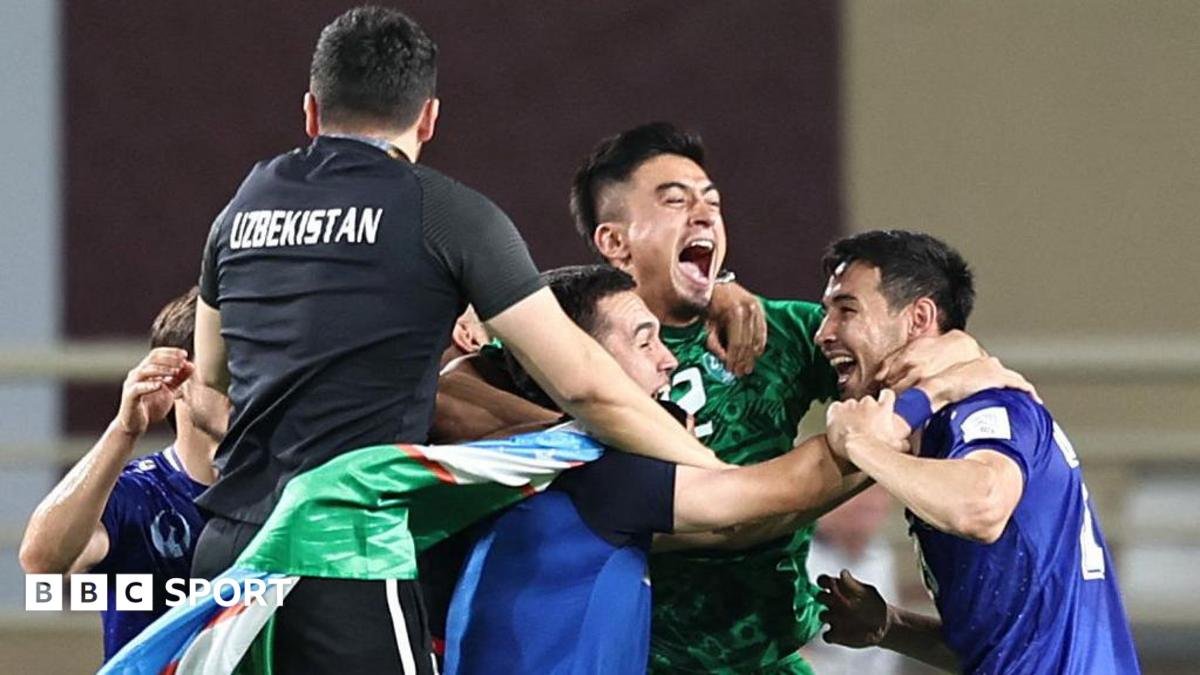
Image source, Getty Images Image caption, Uzbekistan qualified for their first World Cup with a goalless draw against the UAE ByCharlotte CoatesBBC Sport journalist Published 4 hours ago For the first time in World Cup history, Central Asia will have representation after Uzbekistan created history on 5 June 2025.
A 0-0 draw with the United Arab Emirates triggered wild scenes in Tashkent and beyond as Uzbekistan's participation in the 2026 World Cup was confirmed.
The White Wolves are not a traditional footballing powerhouse, but qualifying for the World Cup has been a long time coming, with numerous heartbreaks along the way making their 2026 journey all the more special.
The nation had earned the tag of Asian football's "nearly men", having narrowly missed out on three World Cups this century, but the slate can be wiped clean as Uzbekistan embark on a new journey this summer.
Before their Group K opener against Colombia, Uzbekistan football expert Conor Bowers told BBC Sport that, for the country, qualification is as "significant as winning it would be for nations like England".
Bowers said: "Uzbekistan have historically always been the nearly men of Asian football, having missed out on previous tournaments due to poor refereeing decisions in 2006 World Cup qualifying and utter self-sabotage before the 2022 World Cup.
"The success of qualification has already begun to create noticeable results domestically, with new football clubs being created, previously defunct clubs re-emerging and the number of professional clubs in the country increasing by 36% from the years 2025 to 2026 alone." Drawn in a group alongside Portugal, Colombia and fellow debutants DR Congo, expectations around what Uzbekistan can produce in the World Cup have understandably risen.
But Bowers said: "Qualification was the goal.
Anything more than that will be seen as an additional bonus." Khusanov named in Uzbekistan's World Cup squad Published 2 June Uzbekistan: Asia's 'heartbreak' team finally reach the World Cup Qualification 'not been overnight success story' In 2006, when they placed 45th in the Fifa rankings - five places lower than they are now - Uzbekistan controversially lost a two-legged intercontinental play-off against Bahrain.
A 1-0 first-leg home win was ordered to be replayed in full because the referee incorrectly awarding a free-kick to the visitors when an Uzbekistan attacker encroached during a team-mate's penalty.
They drew the replay 1-1, and it was 0-0 in the away leg, meaning an away-goals defeat - something Uzbekistan fans will never forget.
In 2014 Uzbekistan missed out on goal difference to South Korea.
Then in 2018 they were two points short of qualifying for the tournament in Russia, with South Korea edging them out again after the two sides drew 0-0 in Tashkent in the final group game.
It is no wonder qualifying for 2026 drew such jubilation, but it was merely a reflection of the progress in Uzbekistani football in the past decade.
"The qualification to the World Cup has not been an overnight success story, with it being the goal of a long-term development plan to increase the standards of Uzbek football as a whole," said Bowers.
"New expectations when it comes to stadium standards, coaching, opening up of Uzbek football association academies in multiple regions of the country and further youth development, among others, has raised the level of professionalism occurring within the domestic game.
"This has had a trickle-down impact on success initially at both youth level - Under-17 and Under-20 Asian Cup winners, Olympic qualification, Under-17 World Cup qualification, among other youth finals and semi-finals on an continental level - and senior level.
"The Uzbekistan FA has recently opened up a national training centre outside Tashkent similar in concept to St Georges' Park to provide national teams of all levels high standards of facilities for training." From Djeparov's mullet to Uzbekistan's Beckham Image source, Getty Images Image caption, Abdukodir Khusanov started last season's Carabao Cup and FA Cup finals as Manchester City won both Manchester City signed Uzbekistan defender Abdukodir Khusanov in January 2025 from Lens for a fee worth £34m.
A relatively unknown 20-year-old at the time, Khusanov's stature in the City side and in the Premier League means he is already the face of Uzbekistani football.
But paving the way for Khusanov, now 21, was Server Djeparov - the only Uzbek to be crowned Asian footballer of the year.
He did this not once, but twice.
Recognised by his famous mullet, Djeparov had trials at Chelsea and was a part of the Uzbekistan side that missed out on the World Cup three times.
But now, there is a new hero in Khusanov and Bowers compares the impact in his home nation to that of David Beckham in England in the early 2000s.
He said: "Khusanov's rise from Minsk to Manchester has been incredible and his impact on Uzbek football relative to his age and experience is difficult to measure.
"Uzbekistan has had players play for big historical European clubs like Roma and Dynamo Kyiv, but Khusanov's move in the age of social media and the reach of English football globally has seen Khusanov become similar to how David Beckham was back in the early 2000s, being who kids want to be and the face of the national team.
"It's too early to measure his impact on kids playing football, but the longer he spends at a club like City, the bigger it will undoubtedly be.
"We have already seen players get trials or join prominent European sides, or be expected to join soon, in very good level leagues in Belgium and Portugal, so the impact is perhaps already being felt." Uzbekistan forward Jaloliddin Masharipov told BBC World Service about Khusanov's stardom in his home country: "He's the first guy in the Premier League in Uzbekistan.
"All the fans love him now but fans love all the players here who play national team.
Every time you go outside, go to a restaurant, people come for a picture.
"You go to a restaurant, you don't pay.
Respect, like this here." Image source, Getty Images Image caption, Server Djeparov was capped 128 times by Uzbekistan Cannavaro adds experience It has been all change for Uzbekistan since they realised their dream.
Italy legend and 2006 World Cup-winning captain Fabio Cannavaro will guide them to the World Cup this summer after taking over from Timur Kapadze in October 2025.
Cannavaro is expected to help meet the demands of a first World Cup and was recently hired to add the international experience, nous and gravitas that the nation lacks.
"I want warriors," Cannavaro said after overseeing a 3-1 friendly victory over Gabon at a packed Milliy Stadium during the March international break.
"I want high intensity, always.
This is the key for me, to have fighters.
"We will go to the World Cup to face top teams and, if people think it's easy, they will make a mistake.
"It's Uzbekistan's first time at the World Cup and we go to face everyone without fear." Bowers said: "Despite initially being seen as a disappointing and underwhelming choice to replace interim manager Kapadze, who was very popular, Cannavaro has undoubtedly thrown himself into his role with consistent appearances at Uzbek Super League games, meeting Uzbeks playing abroad and holding a number of training camps already.
"I believe he will bring his experience from his time in the Italian national team, his flexible but pragmatic management style and his passion for the role will ideally allow Uzbekistan to play as well as they can in the matches." Image source, Getty Images Image caption, Fabio Cannavaro won 136 caps for Italy What information do we collect from this quiz?
The World Cup and beyond Reaching a 48-team World Cup was the goal for Uzbekistan.
They might fancy their chances in a relatively weak group, but Bowers says the focus should be on consistent World Cup qualification.
He said: "Uzbekistan should aim for this World Cup to be the first of many and ideally become a regular Asian nation at the tournament like Japan and South Korea.
"At youth level they are consistently among the strongest teams in any tournament despite often sending very young squads relative to their competition.