India is going “beyond advocacy” on the Russia-Ukraine conflict, External Affairs Minister S.
Jaishankar said on Sunday (October 4, 2026), indicating for the first time that New Delhi is involved in conveying messages between Moscow and Kyiv on agreements for maritime safety in the Black Sea and grain export agreements.
Russia welcomes India’s contribution to end Ukraine crisis: Kremlin spokesperson Speaking at a German think-tank’s event, Mr.
Jaishankar responded to questions about India’s close ties with Moscow and its purchase of Russian oil, by pointing out that Russia has “stood by India” in difficult times.
In a talk about ‘Emerging and Middle Power Cooperation’, the External Affairs Minister took aim at global superpowers, the U.S. and China.
Calling the U.S. a “lonelier power” today, while China sets itself apart as a “unique country”, he suggested that other countries could seek to build coalitions with each other to work on issues like international peace and security, supply chain resilience, and connectivity.
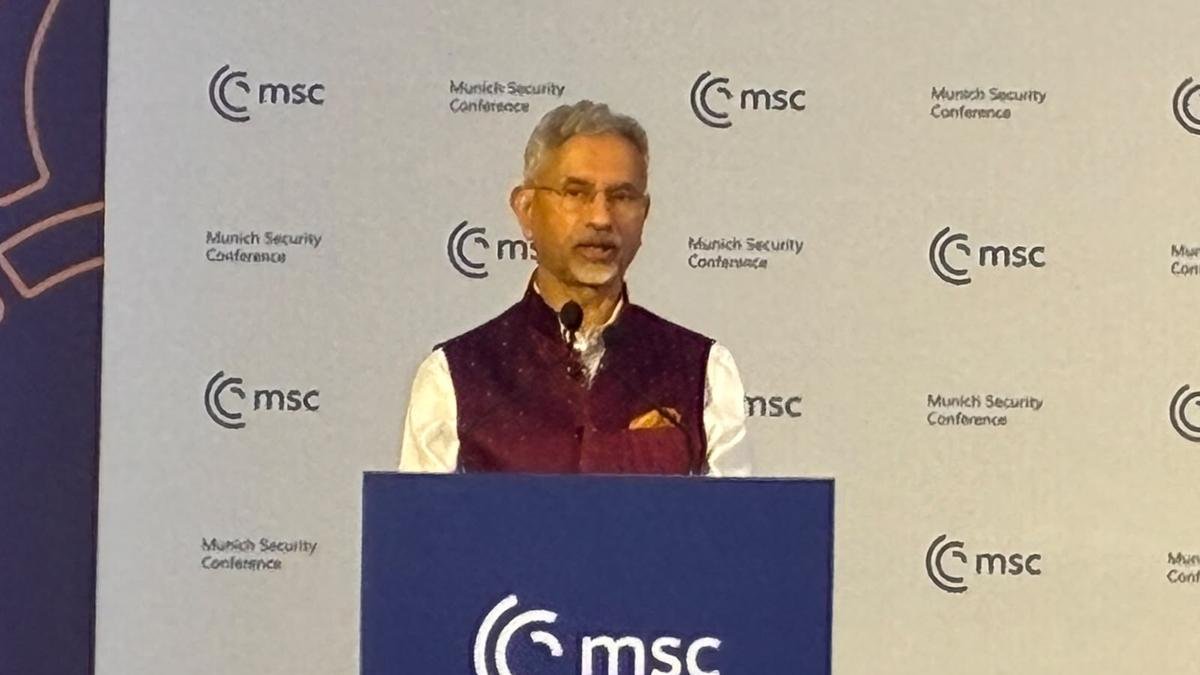
“We have conversations with both Russia and Ukraine [on the need for dialogue and diplomacy],” Mr.
Jaishankar said at the Munich Leaders Meeting in Delhi on Sunday (October 4).
“We are trying to be helpful, starting with the Black Sea safety of shipping issue, but going beyond that to cover some immediate concerns which both of them have on grain exports, on energy exports, on non-attack possibilities.
So those are ongoing conversations right now,” he added.
Time-tested ties Mr.
Jaishankar’s strong defence of India-Russia ties suggests that New Delhi will not reduce its Russian oil purchases, which currently account for over 50% of India’s oil imports, even in the face of possible U.S. sanctions under a new law enacted on September 18.
“For [India,] Russia, and the Soviet Union before that, was a country that stood by us in many ways when our security, when our territorial integrity was under threat, and at a time when you know much of the world preferred backing a military regime next to us,” he said, referring to Soviet support during the 1971 India-Pakistan war and the liberation of Bangladesh.
Indian peace proposal This is the first time Mr.
Jaishankar has divulged details of his discussions during recent visits to Moscow and Kyiv, and his talks with Ukrainian and Russian Foreign Ministers on the sidelines of the UN General Assembly last week.
Prime Minister Narendra Modi met Ukraine President Volodymyr Zelenskyy in France in June and has met twice with Russian President Vladimir Putin in Bishkek and Delhi in the past month, where he publicly raised the need to go from “endless wars” to the “end of war”.
Mr.
Jaishankar’s comments, as part of a Munich Security Forum session entitled ‘From New Delhi to New Momentum: Opportunities for Emerging and Middle Power Cooperation’, came a day after Ukraine Foreign Minister Andre Sybiha told journalists in Kyiv that India had the “broadest” proposal amongst four countries that had offered to help resolve the conflict that began with Russia’s invasion in February 2022.
At the Valdai forum in Russia this week, Mr.
Putin also acknowledged Mr.
Modi’s “very good ideas for finding mutually acceptable solutions” to the conflict.
‘U.S. is a lonelier power’ In his speech, the External Affairs Minister referred to the “changing global landscape” as a cause for concern.
“The landscape today is primarily marked by a radical repositioning of the United States. a repositioning which is a posture of choice, and where in a way it has deliberately become a lonelier power,” he said, adding that another feature of the ‘landscape’ is the “rise of China, which sees itself as a unique country that it is in a way…and we are looking at very sharp competition…that has led to a weaponisation of any leverage that any country has.” Later in the evening, Mr.
Jaishankar hosted a dinner at the Red Fort for participants of the dialogue, including German Secretary of State in the Foreign Office Bernhard Kotsch, Cambodian Secretary of State for Foreign Affairs Meas Kim Heng, former British Foreign Secretary David Lamy, and the Ambassadors of several countries, including the U.S., Canada, and Germany.