FCNR(B) windfall for banks explained: Who got highest inflows and what it means for investors ETMarkets.com Synopsis FCNR(B) deposits offer banks a cheaper and balance-sheet-efficient source of funding, but their finite tenor and initial deployment challenges could pressure margins.
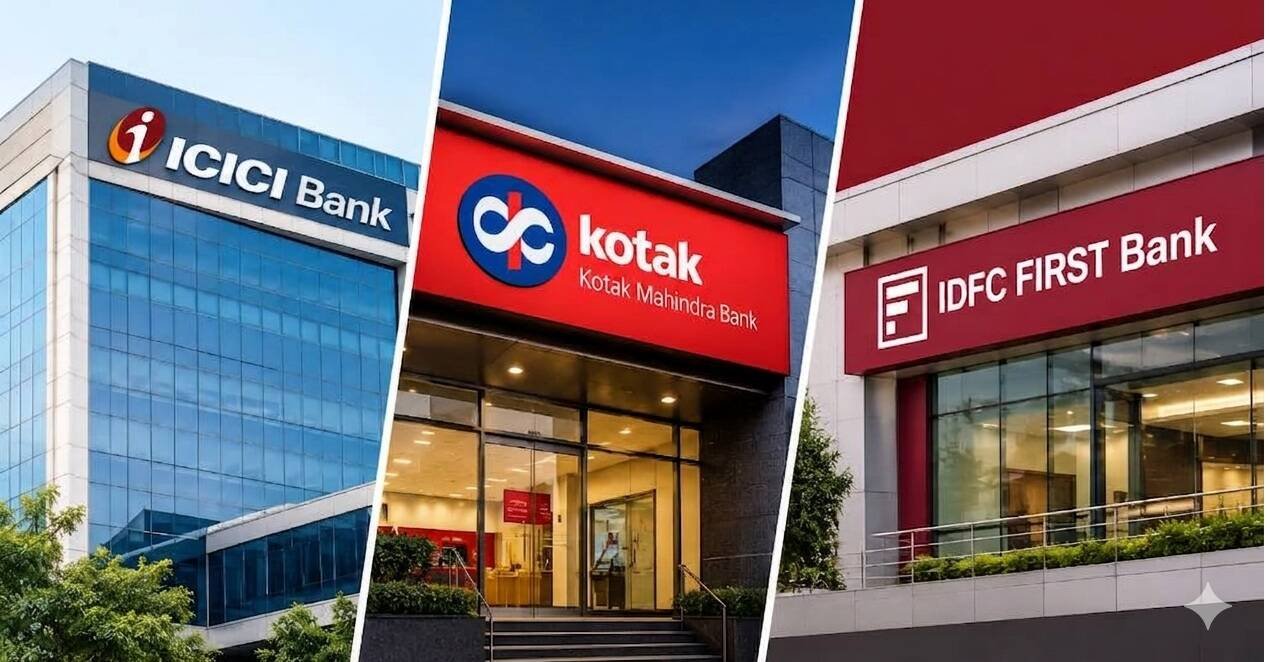
While ICICI Bank and Kotak Mahindra Bank stand to benefit from higher inflows, IDFC First Bank offers the strongest earnings upside.
Investors may see margin pressure initially before stronger liquidity, loan growth and lower funding costs support earnings.
By Nikhil Agarwal, ETMarkets.com XPeers State Bank of India Share Price Union Bank of India Share Price Punjab National Bank Share Price Bank of Baroda Share Price Indian Bank Share Price Last Updated: Sep 08, 2026, 12:37:00 PM IST 1 Follow us India’s banks have secured a flood of foreign currency deposits in a matter of weeks, easing one of the sector’s biggest constraints, but the benefits are set to be uneven.
Large private and mid-tier lenders have captured a disproportionate share of the FCNR(B) inflows, while public sector banks have lagged.ADVERTISEMENT Cumulative foreign exchange inflows under the Reserve Bank of India’s dollar rupee swap facility reached $136.4 billion by August 31, according to Nomura.
FCNR(B) deposits accounted for $127.2 billion, or 93% of the total.The surge accelerated sharply after the deadline for the facility was brought forward.
FCNR(B) inflows jumped from $65.4 billion on Aug.
21 to $127.2 billion by month-end, far exceeding initial expectations of $50 billion-$60 billion.
The inflows are expected to lift system deposit growth in fiscal 2027 to 15.4%, from Nomura’s earlier estimate of 12%.
Also Read |Private banks’ profit margins recover as FCNR(B) inflows ease deposit funding pressureICICI Bank received the most ICICI Bank was the biggest beneficiary in absolute terms, accounting for 14.1% of industry FCNR(B) flows, compared with its 7.1% share of deposits.
For Axis Bank, the inflow was equivalent to 8.8% of deposits, compared with 3.8% for HDFC Bank.ADVERTISEMENT ADVERTISEMENT Kotak Mahindra Bank secured Rs 848 billion, but the amount represented 14.8% of its deposit base—the highest among large private banks.Among mid-tier lenders, IDFC First Bank mobilised Rs 341 billion, equal to 10.9% of deposits.
Federal Bank received Rs 325 billion, while YES Bank attracted Rs 327 billion.
IndusInd Bank’s estimated FCNR(B) deposits stood at Rs 242 billion.ADVERTISEMENT Private banks are regaining their funding advantage The FCNR(B) inflows arrive after a period in which private banks faced tighter liquidity and elevated deposit costs.
During that period, public sector banks gained loan market share by using excess liquidity buffers to fund credit growth.Nomura expects that trend to reverse.
The fresh deposits should allow private lenders to re-enter lower-yielding, but strategically important segments such as mortgages and higher-rated corporate loans.ADVERTISEMENT Private banks are expected to record deposit growth of 18%-24% in fiscal 2027, compared with 13%-16% for public sector banks, according to Nomura’s estimates.The brokerage expects private banks to recover the loan market share lost during the liquidity-constrained period as the FCNR(B) deposits are deployed through the rest of fiscal 2027 and fiscal 2028.Mid-tier banks could see the biggest earnings gains The size of the FCNR(B) benefit depends on two factors: the deposits mobilised as a proportion of the bank’s balance sheet and the spread that the bank can earn after deploying the funds.That makes mid-tier banks particularly attractive.
IDFC First Bank has an estimated FCNR(B) deposit share of 10.9% and a potential spread of 6.18% on loans funded by those deposits.
YES Bank’s FCNR(B) deposits are estimated at 10.4% of deposits, with a potential spread of 2.30%.Nomura expects IDFC First Bank to see the biggest upgrade to fiscal 2028 pretax earnings at 12%.
The brokerage expects upgrades of 7% for YES Bank, 5% for IndusInd Bank and 4% for Federal Bank.Among large private banks, Kotak Mahindra Bank is expected to see a 4% pretax earnings upgrade, while ICICI Bank and Axis Bank could see 3% upgrades each.
HDFC Bank is expected to see only a 1% upgrade because its FCNR(B) inflows account for just 4% of first-quarter deposits.For State Bank of India and Bank of Baroda, Nomura expects pretax earnings upgrades of only 1% each.
Their FCNR(B) inflows are smaller relative to their deposit bases, and their loan yields are lower.Nomura’s preferred large private banks are ICICI Bank and Kotak Mahindra Bank.
Within the mid-tier segment, it prefers IDFC First Bank, IndusInd Bank and Federal Bank.
The brokerage remains cautious on public-sector lenders.Why bank margins could fall first The FCNR(B) deposits are not an immediate earnings windfall.
Banks must first deploy the money, and surplus funds may initially be parked in reverse repos, Treasury bills, commercial paper or other short-duration instruments.Nomura expects margin compression for two to three quarters as banks carry undeployed deposits at negative spreads.
Kotak Institutional Equities estimates that net interest margins could compress by 10-30 basis points under different deployment scenarios.The eventual outcome will depend on how quickly banks deploy the funds into loans, repay higher-cost borrowings or keep the money in lower-yielding investments.
Earnings accretion is highest when the deposits are fully deployed into loans, followed by the repayment of wholesale borrowings.
Keeping surplus liquidity in low-yielding instruments produces the weakest outcome.The brokerage expects the banking industry’s net interest margins to find a floor after the full impact of the deposits is absorbed over the next two quarters.A three-to-five-year funding boost FCNR(B) deposits are primarily for three to five years.
They are therefore finite-tenor liabilities rather than a permanent source of funding.
But the reports highlight their balance-sheet advantages: the deposits are considered efficient from the standpoint of statutory liquidity ratio, cash reserve ratio, liquidity coverage ratio and priority-sector lending requirements.Bank of America said the deposits are not necessarily an expensive source of funding.
Large banks have generally offered interest rates of about 5.25%-6% on foreign currency deposits, compared with around 6.5%-7.5% for conventional three-to-five-year deposits.
The foreign exchange risk is borne by the RBI under the structure.The deposits could also help lower funding costs if banks use them to repay expensive borrowings or replace higher cost deposits.
Kotak expects the credit-deposit ratio to moderate further from 82% as deposit growth catches up with loan growth.For investors, the FCNR(B) episode is therefore a balance sheet opportunity rather than a simple near term profit trigger.
ICICI Bank has gained the most in absolute terms, Kotak Mahindra Bank has one of the highest deposit exposures among large private lenders, and IDFC First Bank appears best positioned for earnings upside.