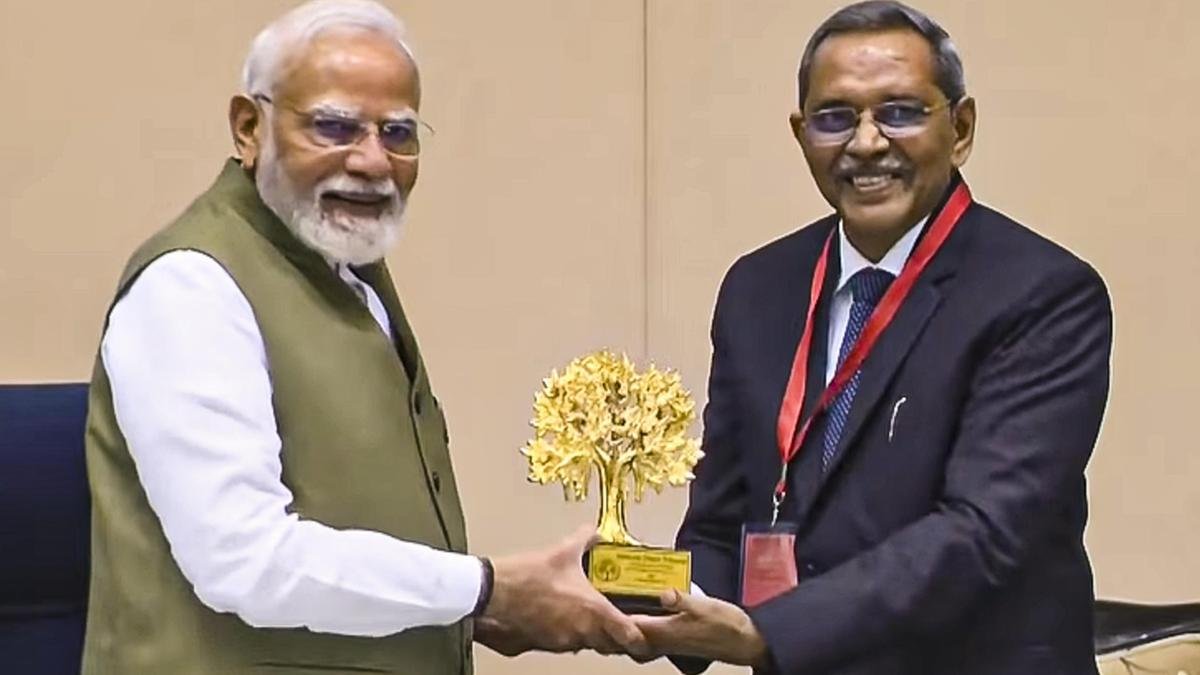
Prime Minister Narendra Modi on Saturday (September 19, 2026) said the responsibility for carbon emissions had often been “wrongly placed” on developing countries.
He also claimed that India was the only G20 country to have fulfilled all the commitments it made at the 2015 Paris climate summit, and that it had done so ahead of schedule.
Mr.
Modi was speaking at the inauguration of a two-day international conference on “The Future of Environment and Climate Dynamics”, organised by the National Green Tribunal (NGT) at Vigyan Bhawan.
The conference brings together jurists, academics, policymakers, scientists and experts from 17 countries, along with the United Nations Environment Programme (UNEP) and the Asian Development Bank.
The NGT said the aim is to identify gaps in policymaking and implementation, and strengthen cooperation among institutions.
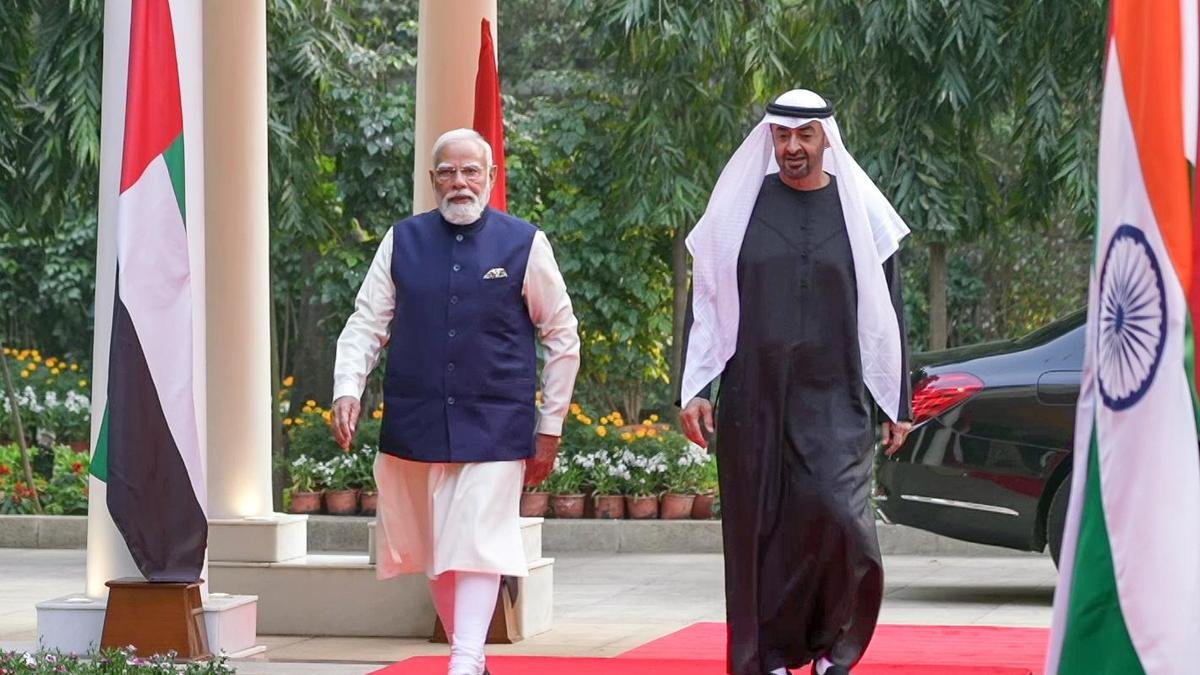
PM Modi, UAE Preident discuss West Asia, strategic partnership during phone call “We all know that often the responsibility for carbon emissions has been wrongly placed on developing countries.
Many of my companions from the Global South are present here,” he said, addressing the gathering in Hindi.
“But the historical truth is that even today, India’s per capita carbon emissions are less than half the global average.” The per capita emissions in developed countries were six times India’s, he noted and said solar capacity had grown from about 2 GW to more than 160 GW in 12 years, and that non-fossil capacity had nearly quadrupled.
“Those who give long speeches on the environment – when I advance nuclear energy work, they will stand in the courts to stop it,” he added.
“A pathway has also been created to bring private players into this sector.” The SHANTI Act from December 2025, enables this.
Rajasthan order asking students to join PM Modi's birthday celebrations sparks controversy On track Independent assessments support part of Mr.
Modi’s Paris claim.
India’s first Nationally Determined Contribution (NDC) had three quantitative targets.
The emissions-intensity and non-fossil capacity goals were both met several years early, and non-fossil capacity reached 52.57% of the total by February 2026.
The third target, an additional carbon sink of 2.5-3 billion tonnes of CO2 equivalent by 2030 through afforestation, is still in progress.
India’s April 2026 submission to the UN puts the additional sink at 2.29 billion tonnes between 2005 and 2021 and says the country is on track.
Globally, the UNEP estimates that warming in this century would be 2.3-2.5 degrees Celsius even if all countries’ NDCs are fully implemented, and 2.8 degrees C under current policies.
This is short of the Paris goal of keeping warming “well below” 2 degrees C while pursuing 1.5 degrees C.
The UNEP’s Limiting Overshoot report, released on September 2, found that warming is set to cross 1.5 degrees C, likely within the next few years, and put the best-case peak at 1.8 degrees C.
The Prime Minister’s remarks follow the August 26 Nepal flash flood, caused by a glacier collapse.
More than 1,300 people have been confirmed dead in the deluge.
Following the disaster, Foreign Minister Shisir Khanal told the media that major emitters, including India, had a historical responsibility to compensate vulnerable nations, calling it “not a matter of charity”.
He later said neither he nor Nepal’s government had asked India, China, the United States or any other country for compensation, and that the call was for the global community to see the disaster through a climate lens.
Nepal has approached the UN Loss and Damage Fund.