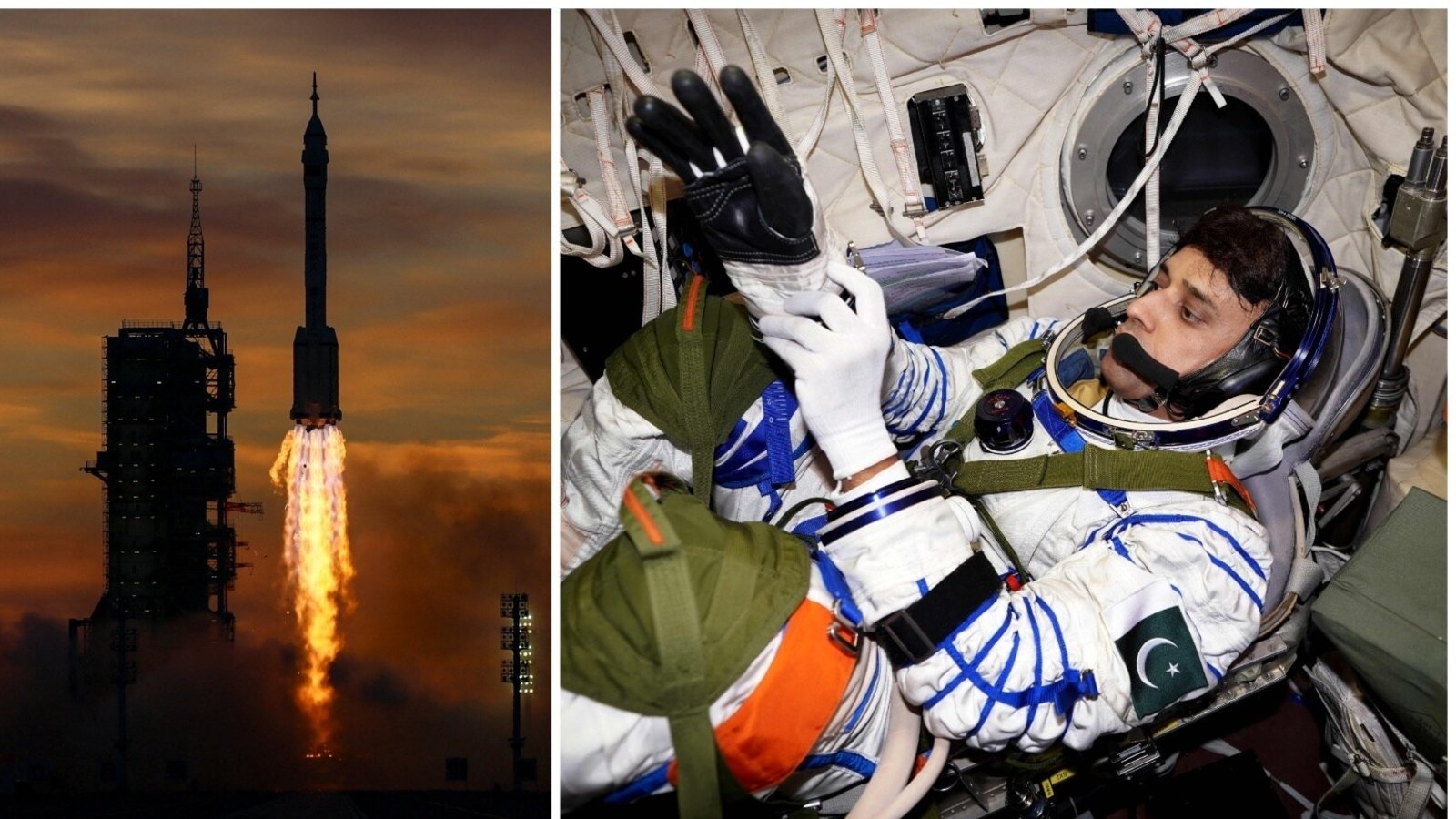
Trending News China launches Pakistani astronaut into space aboard its Long March 2F rocket Three astronauts travelled to space aboard China's Long March 2F rocket, whose name is rooted in the historic 12,500-km Long March of the 1930s.
Updated on: Nov 25, 2026, 07:44:04 IST Edited byAnita Goswami Share via Copy link China launched three astronauts into space on Wednesday as part of its Shenzhou-24 mission to the Tiangong space station.
The three-member crew comprises spacecraft pilot Tang Hongbo, flight engineer Wu Yi and Pakistani astronaut Muhammad Zeeshan Ali, as per Chinese media.
It is the first time a foreign astronaut has travelled aboard a Chinese crewed spacecraft.
Pakistani astronaut Muhammad Zeeshan Ali travelled to space aboard China's Long March 2F rocket, (AFP/Reuters) A Long March 2F rocket carrying the crew lifted off from the Jiuquan Satellite Launch Centre in the country's northwestern Gobi Desert at 8:18am local time, AFP reported citing state broadcaster CCTV.
They will travel to the Tiangong space station to conduct scientific experiments and other activities as part of China's ongoing human spaceflight programme.
What is the Shenzhou-24 mission China's latest crewed spaceflight mission, Shenzhou-24's main objective is to take astronauts to the Tiangong space station, where they carry out scientific research and other activities.
The mission is part of China's ongoing efforts to operate and maintain its space station.
According to the China Manned Space Agency (CMSA), the mission includes around 90 scientific experiments and technology tests.
These cover areas such as space biology, medicine, materials science and physics.
About the Long March 2F rocket The Long March 2F, also known as Chang Zheng 2F or CZ-2F, belongs to China's Long March family of launch vehicles, which has been used for satellite launches, space station missions and human spaceflight, as per the Federal Aviation Administration.
It is currently China's only active launch vehicle designed to carry humans.
The rocket was developed by the China Academy of Launch Vehicle Technology (CALT), a major aerospace organisation under the China Aerospace Science and Technology Corporation (CASC).
According to the China Manned Space Engineering Office, development of the Long March 2F began in 1992.
It completed its first successful flight on November 20, 1999.
The name 'Long March' refers to the historic Long March undertaken by Chinese Communist forces between 1934 and 1935, covering thousands of kilometres across China, as per outlet CGTN.
China uses the name for its family of space launch vehicles.
Specifications of the Long March 2F The Long March 2F is a two-stage rocket with four liquid-fuel boosters attached to its main body.
Its design allows it to generate the thrust needed to lift a crewed spacecraft into low Earth orbit.
First launch: November 20, 1999 Height: 58.34 metres (around 191 feet) Number of boosters: 4 Core diameter: 3.35 metres (around 11 feet) Liftoff thrust: Around 600 tonnes-force Payload capacity: More than 8,100 kg (8.1 tonnes) to low Earth orbit Launch site: Jiuquan Satellite Launch Centre, China Main purpose: Launching astronauts and crewed spacecraft into orbit Safety feature: The launch escape system How the spaceflight works First stage and boosters: The rocket has four boosters attached to its first stage, according to the FAA.
Both use YF-20B engines powered by two liquid fuels: unsymmetrical dimethylhydrazine (UDMH) and dinitrogen tetroxide.
They provide the thrust needed to lift the rocket off the ground.
Second stage: After the boosters and first stage separate, the second stage takes over.
It uses a YF-24B engine to accelerate the rocket and place the spacecraft into orbit.
Spacecraft separation: Once the rocket reaches the required orbit, the Shenzhou spacecraft separates from it and continues its journey towards China's Tiangong space station.
Safety features in the Long March 2F Launch escape system: The rocket has an emergency escape tower fitted above the Shenzhou spacecraft.
It uses powerful motors to pull the crew capsule away from the rocket if a problem occurs during launch.
Emergency crew protection: The escape system allows astronauts to move away from the rocket and return safely to Earth inside the capsule in case of a launch emergency.
Monitoring systems: The rocket has onboard systems to monitor its performance and detect technical problems during flight.
Escape tower separation: The escape tower is jettisoned about two minutes after liftoff, once it is no longer needed.
History of the Long March 2F rocket The Long March 2F made its first flight on November 20, 1999, carrying the uncrewed Shenzhou-1 spacecraft.
The mission helped China test its spacecraft and prepare for future human spaceflight missions.
A major milestone came in October 2003, when the rocket launched Shenzhou-5 carrying astronaut Yang Liwei.
He became the first Chinese citizen to travel into space.
With this mission, China became the third country, after the Russia and the US, to independently send a human into space.
The rocket continued to support China's crewed space programme, including missions to its experimental space laboratories.
In 2021, it launched Shenzhou-12, carrying the first crew to China's Tiangong space station.
Later that year, it also launched Shenzhou-13, whose crew spent six months aboard the station.